Can you win a New York Times Learning Network writing contest if English is your second language? Yes — entries are judged as writing, not as language exams, and multilingual students bring material and perspective that monolingual writers cannot fake. But second-language drafts fail in predictable ways: translated idioms, borrowed formality, and “thesaurus English.” This guide names the five most common ESL pitfalls, shows the fixes, and lays out a revision workflow built specifically for students drafting in their second language.
Judges read writing, not passports
The Learning Network’s student contests — the full family of contests is mapped here — are open to students worldwide, and published winners over the years have included students writing from outside the United States. Nothing in the publicly posted contest rules awards points for being a native speaker; entries are read for the quality of the thinking, the specificity of the material and the control of the form (always confirm the current rules for each contest on the official Learning Network page).
That matters because many students at Chinese international schools quietly downgrade their own chances before they start: they assume a native-speaking competitor with effortless idiom will always beat them. In our editorial experience reading student drafts from China-based cohorts, the opposite problem is far more common — the drafts that fall flat are not the ones with grammar slips, but the ones where the writer sanded away everything specific about their own life trying to “sound American.” A judge can forgive a slightly stiff sentence. No judge can be moved by a personal narrative set in a generic, placeless suburb that the writer has never actually lived in.
So the strategic position for an ESL writer is: fix the handful of second-language errors that genuinely block comprehension, keep the material that only you have, and stop competing on idiom — compete on observation.
The five ESL pitfalls that actually cost you
Not all second-language errors matter equally. Missing articles (“a”/”the”) rarely sink an entry on their own. These five patterns do real damage because they interfere with meaning or voice:
| Pitfall | What it looks like on the page | The fix |
|---|---|---|
| 1. Translated idiom | A Chinese four-character phrase rendered word-for-word: “the horse arrives and succeeds,” “add oil.” The English reader stalls. | Translate the meaning, not the words — or keep the Chinese phrase in pinyin/characters and gloss it in one clause. Kept deliberately, it becomes texture; translated literally, it becomes noise. |
| 2. Exam-English formality | “It is universally acknowledged that…,” “In contemporary society…,” “plays an important role in…” — openers drilled for IELTS/TOEFL essays. | Delete the first sentence of your draft and see if the second one is the real opening. Contest writing wants a specific image or claim in line one, not a ceremonial throat-clear. |
| 3. Thesaurus English | “Use” becomes “utilize,” “sad” becomes “lugubrious.” Word-list vocabulary pasted over simple ideas. | One rule: never write a word you have not heard used. Big ideas in plain words beat plain ideas in big words — in such a short form (check your contest’s current word limit) there is no room to hide. |
| 4. Hedging stacks | “Maybe it can perhaps be somewhat possible that…” — politeness norms imported into argument writing, which reads as lack of conviction. | In an editorial or open letter, commit: one claim, stated plainly, then defended. Save nuance for the counter-argument paragraph, where it earns credit. |
| 5. Rhythm monotony | Every sentence 18–22 words, subject-verb-object, because that pattern feels “safe.” The paragraph flatlines. | Read the draft aloud. Then deliberately cut one sentence to under six words. Short sentence after three long ones = emphasis. This is the cheapest voice upgrade available. |
Your bilingual advantages — and how to cash them in
Second-language writers hold three assets that Learning Network forms reward, and most students never deploy them deliberately.
- Untapped material. A tiny memoir of barely a hundred words about your grandmother steaming zongzi at 5 a.m., a review of a C-drama or a Chongqing hotpot chain, an editorial on gaokao-versus-IB pressure written by someone actually inside that system — these subjects arrive with built-in originality because the judging pool has not read four hundred versions of them. Specific, local, personally witnessed material is the single strongest differentiator in any contest cycle.
- The outsider’s eye. Writers between two languages notice what native speakers treat as invisible — the strangeness of small talk, of American cafeteria portions, of the word “freedom” doing different work in different countries. That double vision is a classic essayistic engine; use it as your lens, not something to hide.
- Code-switching as texture. A deliberately placed Chinese word — named, glossed, and load-bearing — can do more voice-work than a paragraph of adjectives. The test: the phrase must be doing a job the English could not do. One per entry is seasoning; five is a gimmick.
If you are choosing which contest fits this material best, the 2025-26 contest calendar lists every form and its season — personal material tends toward the narrative and memoir contests, while the outsider’s-eye argument fits the editorial and Open Letters forms.
A revision workflow built for second-language drafts
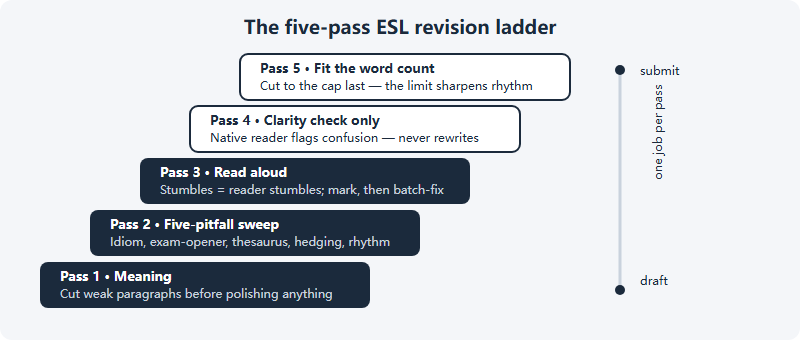
Native-speaker revision advice (“read it aloud and trust your ear”) half-works for ESL writers, because the ear you are trusting is still calibrating. This five-pass sequence separates jobs so no single pass has to do everything:
Questions about the contests?
Scan the WeChat QR code — we help with contest registration, one-on-one topic coaching, and full guidance to the deadline.
Scan the WeChat QR code

- Pass 1 — Meaning (48 hours after drafting). Ignore language entirely. Does every paragraph earn its place? Is the one thing this piece says actually visible? Cut before you polish; there is no point perfecting a sentence you should delete.
- Pass 2 — The five-pitfall sweep. Hunt only for the table above: translated idioms, exam openers, thesaurus words, hedging stacks, rhythm monotony. One pitfall per read-through if needed.
- Pass 3 — Read aloud, slowly. Anywhere you stumble or run out of breath, the reader will too. Mark, don’t fix, then fix in batch.
- Pass 4 — One native-reader check, used correctly. Ask a teacher or fluent friend to mark only the places where meaning is unclear — not to rewrite your sentences. The words must remain yours: Learning Network contests carry strict originality and, in recent cycles, explicit rules about outside and AI assistance, so heavy-handed “editing help” can cross a line as surely as a chatbot can. Confirm the current originality rules for your contest on the official site before submitting.
- Pass 5 — Word-count fitting. Do this last. Cutting to the cap (many Learning Network forms run only a few hundred words; check your contest’s current limit) is where flabby phrases die and rhythm sharpens. Treat the limit as a design constraint, not a punishment.
What not to worry about
Three anxieties that consume ESL contest writers and deserve almost none of your time. First, minor article and preposition slips: fix what you catch, but a piece with two small slips and a beating heart outperforms a grammatically spotless piece with nothing to say. Second, “sounding American”: you are not writing dialogue for a sitcom; you are writing prose, and slightly formal, precise English is a legitimate register — plenty of celebrated essayists in English were not native speakers. Third, vocabulary size: the working vocabulary of most published personal essays is startlingly small. Range of feeling matters; range of synonyms does not.
One genuine caution: do not let anyone — tutor, parent, or AI tool — rewrite your entry into fluency that is not yours. Beyond the rules question, it produces a detectable seam: a 16-year-old’s ideas in a 40-year-old’s sentences. Judges read hundreds of entries; borrowed polish reads as exactly what it is.
FAQ
Do NYT Learning Network judges penalize grammar mistakes from non-native speakers?
Entries are judged as writing, not language exams. Small slips rarely decide outcomes; unclear meaning does. Fix comprehension-blocking errors, keep your specific material, and check each contest’s published criteria on the official site.
Can I include Chinese words or phrases in my entry?
Yes, if each one earns its place — glossed briefly and doing work English can’t. One deliberate code-switch adds texture; several become a gimmick. The entry must still read clearly to an English-speaking judge.
Is it against the rules to have a teacher or native speaker edit my entry?
Feedback on clarity is normal; wholesale rewriting is not. Learning Network contests carry originality rules, and recent cycles address outside and AI help explicitly — confirm the current policy on nytimes.com/learning before submitting.
Should I write my draft in Chinese first and translate it?
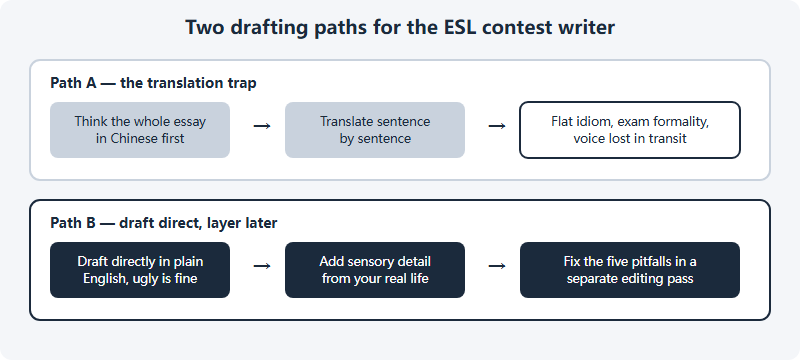
Draft directly in simple English, however plain. Translating a finished Chinese essay produces literal idioms and lost rhythm. Plan in any language you like — but let the sentences be born in English.
This is an independent guide operated by Hanlin Education for China-based international-school students. It is not affiliated with, endorsed by, or sponsored by The New York Times Company or its Learning Network. Contest details change; always confirm current rules, dates and eligibility on nytimes.com/learning. Factual errors flagged to our editorial desk are corrected within 7 working days.