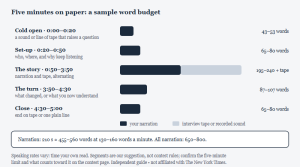
Cutting to a word limit is a sequencing problem, not a deletion problem. Work in four passes — scaffolding, redundancy, compression, sacrifice — and reread between each. In our editorial desk's experience, most student drafts shed close to a third of their length before a single idea disappears, because that third is signposting and hedging. Confirm the exact cap for your contest on the official Learning Network page; caps differ by contest and by cycle.
Why the last stretch is a craft problem
Almost every over-length draft is cut in one of two bad ways. The first is amputation: the writer deletes the final paragraph, because it is at the bottom and looks optional. It is not optional. In a short entry the last paragraph is usually where the consequence lives — the reason a reader should care that you were right. Removing it leaves a piece that states something and then stops.
The second is planing: shaving a word or two from every sentence until the whole thing fits. This preserves the outline and destroys the texture. You end up with a piece in which nothing is quite fully said, every example is named but not rendered, and the prose has the flat, evened-out quality of something that has been squeezed rather than shaped. A reader cannot articulate what is wrong with it, but they do not finish it.
The productive way to think about a hard cap is that it defines a genre. A short contest entry is not a school essay with fewer words in it; it is a different form with different obligations. School essays are graded partly on demonstrated coverage, so they reward breadth, signposting, and a visible structure. A contest entry is read in a queue by someone deciding whether to keep reading, so it rewards compression, specificity, and momentum. Once you accept that, half the cuts stop feeling like losses.
One first-party pattern we see constantly in drafts from China-based international-school students: a school-essay introduction bolted onto a contest entry. A general statement about the modern world, then a narrowing sentence, then a second narrowing sentence, and finally the actual claim in sentence four. That opening was trained into the writer by an exam rubric that rewards it. In a contest entry it is three sentences of pure overhead, and cutting it is free.
Four passes, in this order
Order matters because each pass changes what the next pass sees. If you start by agonising over which example to sacrifice, you will make that painful decision while the draft is still carrying dead weight you have not noticed. Run the free cuts first and the painful decision may never arrive.
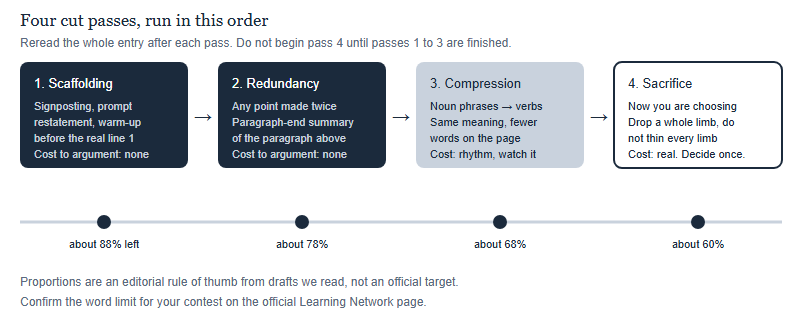
Pass 1, scaffolding. Delete every sentence whose job is to announce another sentence. That includes "In this essay I will argue", "This raises the question of", "It is important to consider", and any restatement of the contest prompt. Also delete the warm-up: the first two or three sentences you wrote to get moving. Almost every draft has them, and almost every draft is better when the piece begins at what was previously paragraph two.
Pass 2, redundancy. Read with a pen and mark every place where a point appears for the second time. The usual offenders are the sentence that summarises the paragraph it sits at the end of, and the second example that proves exactly what the first example already proved. Two examples of the same thing are not twice as convincing; they are one piece of evidence and one piece of padding.
Pass 3, compression. This pass changes wording, not content. It is where the swaps in the table below live. Compression is safe up to a point and then starts to hurt: if every sentence in the entry becomes short and declarative, the prose develops a machine-gun rhythm that reads as amateur. Keep at least some sentences long enough to have a shape.
Pass 4, sacrifice. If you are still over, you now have to remove something real. The rule is to drop a whole limb rather than thin every limb — cut one argument entirely and let the survivors stay fully developed. A piece that makes two points properly beats one that gestures at four.
The safe-cut ladder, and the line below it
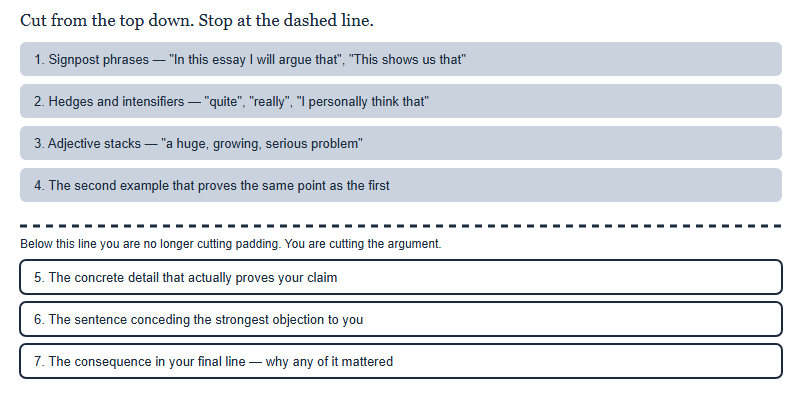
Not all words cost the same. Some layers of a draft carry no argument at all and can go without a thought. Others look like padding and are actually load-bearing.
| Layer | Example | Typical yield | Risk if you cut it |
|---|---|---|---|
| Signposting | "In the following paragraphs, I will explain" | High | None. It only ever slowed the reader down. |
| Hedges | "I think that", "somewhat", "arguably" | Medium | Low — but keep any hedge that is factually load-bearing. |
| Adjective stacks | "an important, urgent and complex issue" | Medium | None. Stacked adjectives weaken each other. |
| Duplicate proof | A second case study making the first case study's point | High | Low, if the survivor is the one you can render in detail. |
| Inferable context | Background a general reader can work out unaided | Medium | Medium — over-cut and your piece becomes hard to follow. |
| Concrete detail | The number, the object, the overheard line | High | High. This is the proof. Cut almost anything else first. |
The hedge row needs a caveat. Some hedges are cowardice — "I personally feel that maybe" — and go without argument. Others are accuracy. If a study found an association and you write that it found a cause, you have not tightened your prose, you have made a false claim. Cut the hedge that protects your ego and keep the hedge that protects the truth.
Questions about the contests?
Scan the WeChat QR code — we help with contest registration, one-on-one topic coaching, and full guidance to the deadline.
Scan the WeChat QR code

Six swaps that buy words for free
Compression is mostly a matter of turning buried verbs back into verbs. English lets you take an action, freeze it into a noun, and then prop it up with a weak verb and two prepositions. Undoing that is close to pure profit: the sentence gets shorter and more direct at the same time.
| Before | After | What is happening |
|---|---|---|
| due to the fact that | because | A conjunction inflated into a phrase |
| she made the decision to leave | she left | A verb frozen into a noun and re-propped |
| there are many students who commute | many students commute | An empty "there is" opener |
| it is important to note that the policy failed | the policy failed | Announcing importance instead of showing it |
| in order to reduce waiting time | to cut waiting time | Two words of connective tissue |
| the results of the survey indicated that | the survey found | A citation frame twice as long as it needs to be |
One boundary on this pass: do not compress a source out of existence. Shortening "the results of the survey indicated" to "the survey found" is good editing. Shortening it to nothing, so that a finding appears in your entry as if it were your own observation, is a different kind of change altogether. Attribution rules and originality expectations are set by the contest, so read them on the official page rather than deciding for yourself what a tight word count excuses.
Two more mechanical gains worth knowing. Contractions save a word each and usually suit the register of a student entry better than the expanded forms. And dialogue tags collapse well: three lines of "he said" and "I replied" can often become one exchange with the speakers made obvious by content.
When the cut starts costing the argument
Sometimes pass 4 arrives and there is genuinely nothing left that does not matter. At that point you have three moves, and they are better than any further shaving.
- Narrow the claim. A smaller claim needs less proof. "School start times harm adolescents" needs a literature review. "My school's 7.20 bell costs my year group its first lesson" needs one observation and one number. Narrowing is the single most effective compression technique that is not about words at all.
- Move context into the title. A title that establishes place and stakes buys your first sentence the freedom to start in motion rather than in exposition. The same trick works in an open letter, where the salutation itself can carry who you are addressing and why, saving a full sentence of set-up in the body.
- Cut a limb, not a slice. If the entry makes three arguments and fits at two, delete one completely and let the other two keep their evidence. Do not keep all three at two-thirds strength.
Then check the mechanics before you submit. Whether your title, byline, sources list or any accompanying note counts toward the limit is a rules question, not a style question, and it differs by contest — confirm it on the official contest page. So is the format the entry must be pasted or uploaded in, since a form that strips your paragraph breaks changes what "finished" looks like. If you are new to the family of contests and unsure which forms carry which conventions, our overview of the Learning Network contests is the place to start.
Finally, build a gap into your schedule. Cutting well requires reading your own sentences as a stranger would, and that is impossible within an hour of writing them. Draft, leave it a day, then cut. Our contest calendar shows how a Learning Network year is typically spaced so you can plan that gap rather than discover on deadline day that you are 200 words over with no time to think. Confirm every date on the official pages before you rely on it.
Frequently asked questions
How much can I usually cut before it hurts?
In our experience a third of a first draft is scaffolding and repetition. Past that you start trading away evidence, so cut in order.
Does my title count toward the word limit?
It depends on the contest and the cycle. This is a rules question, not a style one — confirm it on the official Learning Network contest page.
Should I cut quotations first?
No. Cut the frame around them instead. A long lead-in to a short quote is padding; the quoted evidence itself is usually the proof.
Is it better to draft short and expand?
Usually not. Drafting straight to the cap tends to produce thin claims. Write long, then cut — the cutting is where the thinking happens.
This is an independent guide operated by Hanlin Education for China-based international-school students. We are not affiliated with, endorsed by, or sponsored by The New York Times Company or its Learning Network. Word limits, format requirements, submission mechanics and deadlines are set by the Learning Network and change each cycle — confirm current details on nytimes.com/learning before you submit. Any factual error reported to our editorial desk is corrected within 7 working days.