Past winners are the most useful study material available to you, because unlike professional journalism they were written by someone your age under the same cap and judged by the same criteria. They are also the easiest work to plagiarise without meaning to. The rule that makes studying them safe is simple: take shape and technique, never words, images or topic-plus-structure together.
Where winning work lives, and what you may do with it
The Learning Network announces results for its student contests, and for many contests it publishes selected student work alongside the announcement. Availability varies by contest and by cycle, so start at the announcement post for the specific contest you are entering rather than assuming a full archive exists — confirm what is published on the official site.
Two things follow from where that work is published. First, published winning entries are still the work of the students who wrote them; publication does not put them in the public domain, and you may not reproduce them, republish them, or lift passages into your own entry. Second, the announcement post itself is often as valuable as the entries, because it is often where the editors explain what they responded to. That commentary is the closest thing to a stated rubric written in plain language about actual pieces.
The distinction that matters is between studying and sourcing. Studying means reading a winner to understand how the form works and then writing something entirely your own. Sourcing means treating the winner as raw material for your entry. The first is what every writer does. The second is a violation of the originality expectations that contests publish, and it is more detectable than students think — a judge who has read a few hundred entries recognises a shape they have already awarded.
One first-party note. In drafts we read from China-based international-school students, the most common failure is not deliberate copying at all. It is a student who read three winners in a row, absorbed their cadence, and produced an entry in a borrowed voice — competent, generic, unattributable to a person. That is not a rules problem. It is a craft problem, and it costs entries more often than plagiarism does.
The extraction ladder: what transfers, what never does
Everything you might take from a winning entry sits somewhere on a ladder. The top is free to take because it belongs to the form rather than the writer. The bottom belongs to the writer and is never yours.
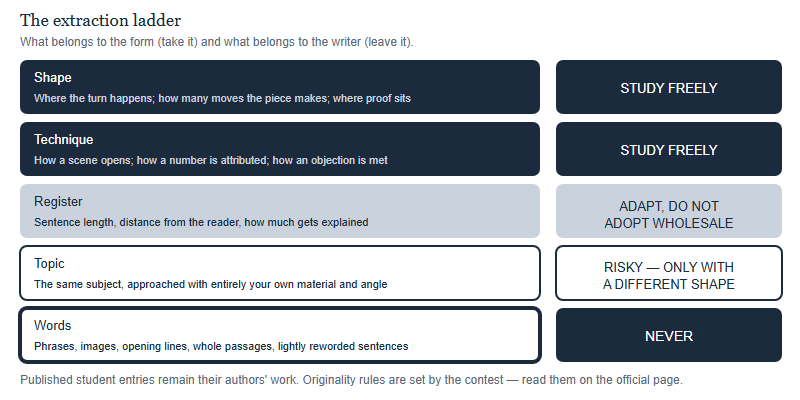
The topic row is where honest students get into trouble. Reading a winning editorial about school phone bans and then writing your own editorial about school phone bans is not automatically wrong — the subject is not owned. But if you also take the winner's structure, its framing of the opposition and its choice of closing move, you have produced a derivative piece even though every sentence is new. The safe version is to keep the subject and change the shape, or keep the shape and change the subject. Never both.
| What you noticed | Wrong use | Right use |
|---|---|---|
| The winner opened mid-action, with no set-up | Rewrite their opening scene with your details swapped in | Find a moment from your own life that can carry an opening, and start inside it |
| They conceded the strongest objection in one sentence | Reuse their concession sentence, reworded | Identify the strongest objection to your claim and write one sentence conceding it |
| They used a single number, attributed plainly | Borrow the number and the source without checking either | Find one number that bears on your claim, verify it at source, attribute it plainly |
| The last line reframed the opening image | Copy the reframing device with their image | Check whether your own opening contains an image worth returning to |
| The voice felt confident but not showy | Imitate the cadence sentence by sentence | Read your own draft aloud and cut what you would not say out loud |
The 20-minute reverse outline
Reading winners passively teaches almost nothing. You finish admiring the piece and none of it is usable. The fix is a structured pass that forces you to describe the machinery rather than enjoy the output. Twenty minutes per entry is enough, and three entries studied this way beats twenty skimmed.
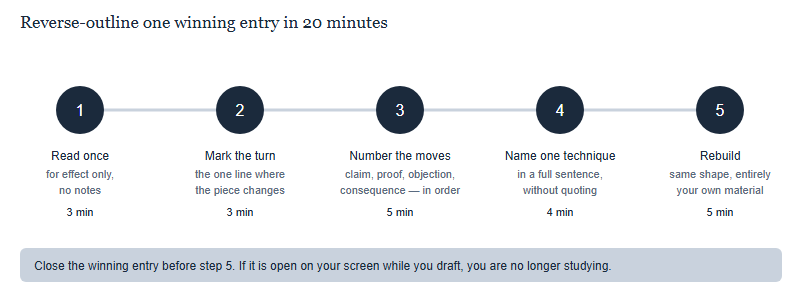
Step 3 deserves expanding. "Numbering the moves" means writing a one-line summary of what each paragraph does — not what it says. "Paragraph 2: gives the number that makes the problem concrete." "Paragraph 3: admits the obvious objection and narrows the claim to survive it." When you have four to six such lines, you are holding the entry's skeleton, which is exactly the thing that transfers. Most students are surprised by how few moves a winning short entry makes.
Step 5 has one non-negotiable condition, written into the diagram: close the original first. The instant a model text is visible while you draft, phrases migrate. This is how honest students end up with sentences they cannot account for. Work from your own one-page skeleton, not from the source.
Reading the judges' commentary as a rubric
The announcement posts are underused. Where the Learning Network explains why particular entries were selected, that commentary tells you which qualities were actually decisive, in the vocabulary the readers themselves used. Collect the recurring adjectives across several announcements and you have a practical working list — far more grounded than guessing.
Questions about the contests?
Scan the WeChat QR code — we help with contest registration, one-on-one topic coaching, and full guidance to the deadline.
Scan the WeChat QR code

Two cautions. First, commentary describes the entries that won in one cycle; it is not a published scoring scheme, and you should not convert it into a checklist of features to install. Second, the criteria that govern your entry are the ones on the official contest page for your contest and your cycle — confirm there. Use commentary as evidence about taste, and the rules page as the authority on requirements.
Read enough announcements and a second, subtler pattern emerges: in the announcements we have read, judges tend to describe effects on the reader rather than features of the text. They report being surprised, convinced, or unable to stop reading — not that an entry contained a counterargument or used varied sentence structure. That is a useful corrective. Students trained on analytic rubrics tend to build entries out of required components, then wonder why a technically complete piece lands flat. The components are necessary and not sufficient; what gets rewarded is what the components do to somebody.
It also pays to notice what the commentary does not praise. In the announcements our editors have read, the qualities most often singled out are specificity, a clear governing idea, and a voice that sounds like a person. Elaborate vocabulary, elegant abstraction and comprehensive coverage rarely appear. That absence is information, and it contradicts a lot of what exam-oriented writing training rewards.
Three ways studying winners backfires
- Voice contamination. Read three winners immediately before drafting and your sentences will come out in an averaged version of theirs. The fix is separation: study on one day, draft on another, and read something in a completely different register — a novel, an essay in translation — in between.
- Ceiling-setting. Students often conclude from winning entries that success requires a dramatic life event. It does not. What the strongest entries share is treatment, not material: an ordinary subject examined closely beats a remarkable subject narrated flatly. If you are stuck for a subject at all, that is a separate problem from studying models.
- Form-blindness. A technique that wins in one contest can be wrong in another. A narrative opening that withholds its meaning is right for a personal-narrative form and wrong for an editorial that has to declare a position early. Before you transplant a technique, check it against the brief for the contest you are actually entering. Our overview of the Learning Network contests sets out what each form is asking for.
There is a scheduling consequence too. Studying models is preparation work, not deadline work — it belongs in the quiet weeks between cycles, when you can afford to read slowly and rebuild skeletons for practice. Our contest calendar shows where those gaps typically fall; confirm all dates on the official pages. If you want a worked example of how a form's specific brief should drive the technique you borrow, our guide to the Open Letters Contest shows how one structural choice — naming a real recipient — reshapes everything after it.
Frequently asked questions
Can I quote a winning entry in my own entry?
Don't. Published entries remain their authors' work, and originality rules are set by the contest. Read them on the official page.
Is writing about the same topic as a past winner allowed?
Subjects are not owned, but change the shape as well. Same topic plus same structure produces a derivative piece even with new sentences.
How many winners should I study?
Three, properly reverse-outlined, beats twenty skimmed. Depth is what makes technique transferable; volume mainly contaminates your voice.
Where do I find past winners?
Start at the announcement post for your contest on the official Learning Network site. What is published varies by contest and cycle.
This is an independent guide operated by Hanlin Education for China-based international-school students. We are not affiliated with, endorsed by, or sponsored by The New York Times Company or its Learning Network. We do not reproduce winning entries, which remain the work of their student authors. Contest criteria, originality rules, published archives and deadlines are set by the Learning Network and change each cycle — confirm current details on nytimes.com/learning. Any factual error reported to our editorial desk is corrected within 7 working days.