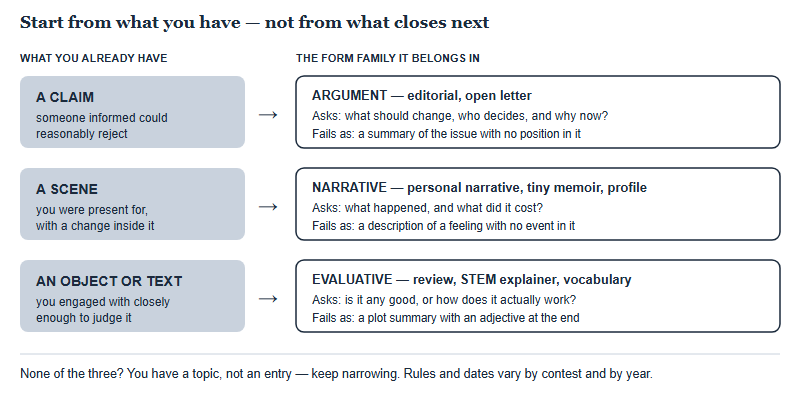
Work backwards from what you have, not forwards from what closes next. Every Learning Network contest asks a different question of the same raw material, and an idea that thrives as an argument can die as a narrative. Before you look at a single date, sort what you are holding into one of three things: a claim, a scene, or an object you can judge.
Deadline-chasing is how good ideas end up in the wrong form
The summer contest has wrapped up for this cycle, and the school-year sequence is still ahead of you. That makes the opening weeks of term the one moment in the calendar when you are not behind — and the only moment when choosing a target is a real decision rather than a reaction.
What usually happens instead is this. A student notices a deadline roughly a fortnight away, looks at the material they happen to have, and forces it into whatever form is closing. The result is a piece that is competent at the sentence level and wrong at the structural level: a personal essay wearing an editorial’s clothes, or an argument with a scene bolted onto the front because someone said openings should be vivid.
Readers notice this before they notice anything else. Each contest exists because a particular kind of writing is worth practising, and the reading is done by people asking whether the piece does the job that form exists to do. A narrative that never lets anything happen has failed even if every sentence is elegant. An editorial with no defensible position has failed even if the subject is urgent.
The Learning Network runs a series of separate contests across the school year, and the line-up, prompts and dates are revised annually. That is exactly why you should not plan from a list you half-remember from last season: check the current sequence on the official Learning Network page, and use our contest calendar overview only as a map of the shape of the year, never as a source of dates.
What each form actually asks of you
Strip away the names and the contests fall into three families, distinguished by the question the reader is holding while they read. The table below is a craft summary, not a rules summary — entry requirements, eligibility and word limits differ by contest and change from year to year, so confirm those on the official Learning Network page.
| Form family | The question it asks | What you must already have | How it fails when the fit is wrong |
|---|---|---|---|
| Editorial (argument) | What should change, and why now? | A claim an informed person could reject, plus evidence from outside your own experience | Becomes a summary of an issue with no position in it |
| Open letter (argument, addressed) | What do I want this reader to do? | A specific addressee with the power to act, and a reason they should care | Becomes a general essay with a name pasted at the top |
| Personal narrative / tiny memoir | What happened, and what did it cost? | A scene you were present for, containing a change | Becomes a description of a feeling with no event in it |
| Profile / coming of age | Who is this, and what do they reveal? | Access to a real person, and their agreement to be written about | Becomes a tribute with no reporting behind it |
| Review (evaluative) | Is this any good, and by what standard? | An object you engaged with closely, plus a criterion you can state | Becomes a plot summary with an adjective at the end |
| STEM / explanatory | How does this work, for someone who does not know? | A mechanism you genuinely understand, and a reason a general reader should care | Becomes a textbook paragraph with the difficulty left in |
| Vocabulary / multimedia | Can you carry meaning in another medium? | An idea that is stronger seen or heard than read | Becomes a written entry with pictures attached to it |
Read down the third column rather than the first. Most students choose by subject — “I care about climate, so I will write the editorial” — when the binding constraint is nearly always what they can actually get their hands on. Caring about a subject is not the same as having evidence, access, or a scene.
One raw idea, five routes — and two of them are dead ends
Take an invented example, so that nothing here is a claim about any real school: your school replaces canteen cash with a payment app. That is raw material, not an entry. Here is what it becomes in five different forms, and why two of those routes are a waste of your term.
- Editorial — workable. The claim is not “the app is annoying”; that is a complaint. The claim is something like: the school moved a cost onto the students least able to absorb it. That is contestable, which is what makes it an argument. It obliges you to find evidence beyond your own inconvenience — who is affected, how many, what the alternative was.
- Open letter — workable, and sharper. Same material, but now you must name someone who can act and ask for one specific thing: publish the fee schedule before the next contract renewal. The discipline of the form is that a vague ask exposes itself instantly. If you cannot say who and what, you do not have this piece. Our guide to the Open Letters contest goes through what an addressee actually has to be.
- Personal narrative — workable, and completely different. Not the policy at all: the lunch you did not eat, the queue behind you, the thirty seconds at the reader while the machine refused. No argument, no statistics, no recommendation. The reader draws the conclusion you never state.
- Review — dead end. You could evaluate the app as an object, but the app is not the interesting thing, and you would spend the whole entry on an interface. Reviews work when the object rewards attention. This one does not.
- Explanatory — dead end, unless. You could explain how contactless payment settlement actually works, but only if you genuinely understand it. Writing an explainer about a mechanism you looked up last week is the fastest way to produce something both dull and slightly wrong.
Three routes out of five, from one piece of raw material. That is the normal ratio, and it is the reason this sorting exercise is worth an evening. The two dead ends would still have produced finished entries — grammatical, on-length, unmemorable.
Four tests before you commit
Once you have a candidate form, run these before you write a paragraph. Each takes about a minute and each has saved students a fortnight.
- The disagreement test (argument forms). Can a reasonable, informed person hold the opposite view? If the honest answer is no, you have an announcement, not an argument. “Bullying is bad” fails. “Our anti-bullying policy makes reporting harder than staying silent” passes.
- The witness test (narrative forms). Were you there, and can you name three concrete things a general reader could not have guessed? Not adjectives — things. If you cannot, you are writing about a memory of a memory.
- The criterion test (evaluative forms). Can you state the standard before you state the verdict? A review that never says what it wanted from the thing is just a preference with paragraphs.
- The ending test (all forms). Do you already know roughly where this stops? Short forms punish pieces that go looking for their ending in the final line. You are allowed to be wrong about the ending later; you are not allowed to start without one.
An idea that fails one test is usually not dead — it is in the wrong family. The canteen complaint fails the disagreement test as an editorial and passes the witness test as a narrative. Move it rather than abandon it.
Questions about the contests?
Scan the WeChat QR code — we help with contest registration, one-on-one topic coaching, and full guidance to the deadline.
Scan the WeChat QR code

Aim at two targets, not seven
The temptation once you know the year has several contests in it is to enter all of them. Resist it. Entering more does not improve anything except your familiarity with submission forms, and it reliably degrades the thing that does matter, which is how many drafts each piece gets.
A workable year is two targets. Pick one form that plays to what you already do well, and one that forces you into a family you have never written — an argument writer taking on a narrative, or the reverse. The first is where you have the best chance of producing something finished; the second is where the actual learning happens. If you want a third, add it only after the first two are drafted.
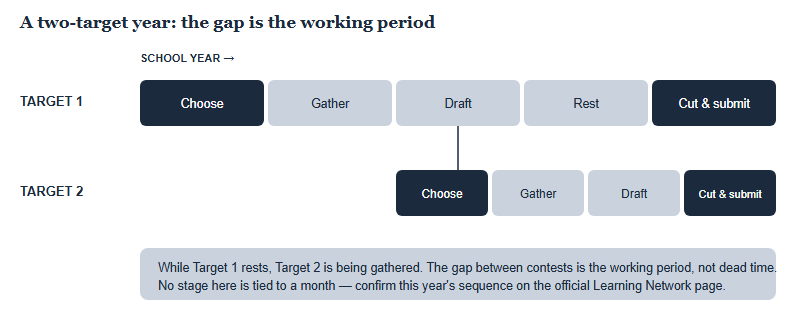
One pattern from our own reading, offered as an observation rather than a rule, and de-identified: among the China-based students we work with, the entries that end up strongest are almost always the ones that existed as a complete draft well before the closing fortnight. Students who decide late and enter several contests at once tend to submit several first drafts. Nothing about entry counts or timing changes the odds of recognition in any contest — results vary, and most entries in any large contest are not recognised — but the number of drafts a piece gets is the one variable genuinely under your control.
If you are new to the sequence altogether, start with our overview of what the Learning Network writing contests are, then come back and sort your material. Choosing well in September is worth more than writing quickly in March.
Frequently asked questions
How do I find out which contest is running right now?
Check the official Learning Network contest page. The line-up and dates are revised annually, so never plan from a list you saw in a previous season.
Can the same piece of writing be entered in more than one contest?
Treat it as a rules question, not a craft one. Entry conditions differ by contest — confirm on the official Learning Network page before submitting.
Is it better to enter many contests or a few?
Few, finished. Two entries drafted early beat five written in a scramble, though no entry count changes the odds of being recognised.
What if my idea does not fit any form?
Then it is still a topic, not an entry. Keep narrowing until you hold a contestable claim, a scene you witnessed, or an object you can judge.
This is an independent guide operated by Hanlin Education for China-based international-school students. We are not affiliated with, endorsed by, or sponsored by The New York Times Company or its Learning Network. Contest line-ups, prompts, eligibility rules, word limits and deadlines are set by the Learning Network and change from year to year — confirm current details on nytimes.com/learning before you plan or submit. Factual errors are corrected within 7 working days of notice.