The New York Times Tiny Memoir Contest — also called the 100-Word Personal Narrative Contest — asks students aged 13 to 19 to tell one true, meaningful story from their own life in 100 words or fewer, not counting the title. You work alone, submit one entry with a short “artist’s statement,” and need parent or guardian permission. It is free and open worldwide. Winners are published on the Learning Network and may appear in print. The 2026-27 window is open now: 16 September to 28 October 2026.
2026-27 at a glance: entries run 16 September – 28 October 2026, and Learning Network deadlines close at 11:59 p.m. U.S. Pacific — about 3 p.m. on 29 October in Beijing. The rules for this season also bar AI drafting, AI editing and AI or Google Translate translation, and most contests will ask you to document your process. Dates and rules here come from two independent republications of the 2026-27 announcement, because nytimes.com blocks our fetching tools — confirm yours on the official Learning Network page before you submit.
Why 100 words is harder than 1,000
Students who are strong at long-form essays often assume a 100-word contest is the easy one. It is the opposite. When you have 800 words you can explain, contextualise, and recover from a slow start. In 100 words every sentence must carry weight, and there is nowhere to hide a vague opening or a soft ending. The Tiny Memoir is a genuine test of craft precisely because the constraint is so tight — it forces you to find the single moment that matters and cut everything else.
The Learning Network describes the task plainly: a short, powerful, true story about a particular moment or event in your own life. Two words there do a lot of work. “True” rules out fiction — this is memoir, not a short story. “Moment” rules out the life summary — judges are not looking for “my whole immigration journey,” they are looking for the ninety seconds that stand in for it.
A first-party observation from coaching China-based writers: the most common failed draft tries to narrate a big theme (leaving home, a grandparent’s illness, learning English) across years. The strongest 100-word memoirs zoom in on one physical scene — a specific kitchen, a specific train platform, one sentence someone said — and trust the reader to feel the larger meaning behind it. Compression is not the enemy of emotion here; it is the delivery system for it.
The rules, laid out (verify each on the official page)
Use this as a shape-of-the-contest reference. Because Learning Network dates and some rule details shift year to year, treat every dated or procedural item as “confirm on the official Learning Network page.”
| Item | What to expect | Source / caveat |
|---|---|---|
| Length | 100 words or fewer, title not counted | Learning Network task |
| Genre | A true personal narrative (memoir), not fiction | Must be from your own life |
| Eligibility | Students aged 13 to 19 in middle/high school worldwide | PG students who haven’t started college may qualify — confirm officially |
| Solo only | You must work alone — no teams for this contest | Unlike some Learning Network contests |
| Entries per student | One entry per student | Choose your best; you can’t hedge |
| Artist’s statement | A short note on your process, submitted with the entry | Not used to pick finalists; helps refine contests |
| Permission & cost | Free; parent/guardian permission required | Built into the form |
| 2026-27 window | 16 September – 28 October 2026, closing 11:59 p.m. U.S. Pacific (about 3 p.m. on 29 October in Beijing) | Per the 2026-27 announcement — confirm on the official page |
| AI and translation | Not allowed: chatbot drafting, AI editing or polishing, AI-generated text or images, and AI or Google Translate translation into English | Entries that break this are disqualified; be ready to show your process |
Three of these deserve emphasis for our readers. The one-entry, solo-only combination means you cannot spread your bets — you submit a single memoir you wrote yourself. The artist’s statement is not judged for finalist selection, so do not agonise over it, but do write it honestly; it exists to help the Learning Network design future contests. And the true-story requirement is a line you must not cross: inventing events would violate the spirit and letter of the rules. If you are entering several contests this year, note how different each one’s format is on the 2026-27 contest calendar.
What judges reward — and the moves that get you there
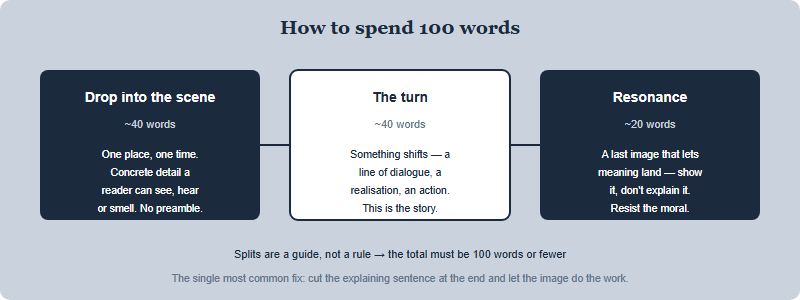
There is no long public rubric for the Tiny Memoir the way there is for some contests, but the finalists the Learning Network publishes share clear traits, and the guidance is consistent: judges want a particular moment, told with vivid specificity, that carries emotional truth. From reading widely across published finalists, four craft moves recur. Treat these as observed patterns, not official scoring criteria.
| Craft move | What it looks like | Why it works in 100 words |
|---|---|---|
| Start inside the moment | First sentence is already in the scene, no throat-clearing | You cannot afford a warm-up; the reader must be present immediately. |
| One concrete anchor | A single physical detail carries the whole memory | Specifics feel true; abstractions feel generic. |
| Show the turn, don’t state it | The shift is dramatised through action or dialogue | Explaining the meaning wastes words and flattens feeling. |
| Trust the ending | Close on an image, not a lesson (“…and that’s when I learned”) | The reader supplies the meaning; that participation is the payoff. |
The deepest revision principle for this contest is a subtraction, not an addition: the last sentence usually needs to be cut. Most drafts end by explaining what the story meant. The strongest tiny memoirs stop one line earlier and let the final image resonate. When you read your draft aloud and feel the ending is “telling” you the point, that is the sentence to delete. For a broader treatment of tightening any entry from draft to submission, the site’s guide on what the contests are and how they work is a useful companion.
A compression method for non-native writers
If English is your second language, the tight word count is actually an advantage — it rewards clarity over vocabulary showmanship. Here is a method that consistently produces a clean 100-word draft without hunting for fancy words.
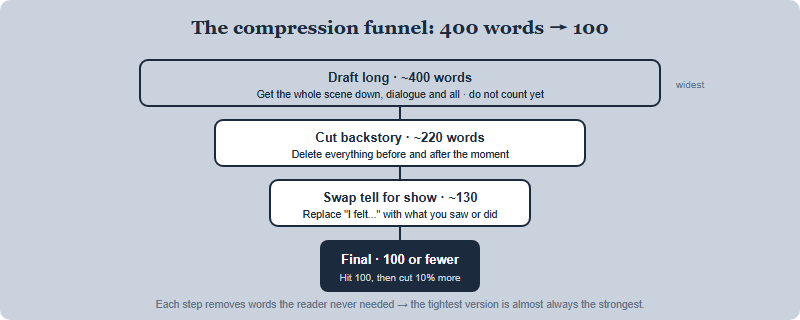
- Write the memory long first (300-400 words). Do not count words yet. Get the whole scene down, including dialogue and detail.
- Find the turn. Underline the single sentence where something changes. That is your centre of gravity; the memoir is built around it.
- Cut backstory ruthlessly. Delete anything that happens before or after the moment. Readers do not need the setup; they need the scene.
- Swap explanation for image. Wherever you wrote “I felt sad / proud / afraid,” replace it with what you saw or did. Emotion shown beats emotion named.
- Count, then cut 10% more. Once you hit 100, remove another ten words. The tightest version is almost always stronger.
- Read aloud and check the rules. Confirm the count, the true-story requirement, permission, and the current window on the official Learning Network page before submitting.
Because you get only one entry, spend real time on topic choice before drafting. A quiet, specific, honest moment almost always beats a dramatic-but-generic one. The best source material is often something small you have never thought of as a “story” — that is usually where the truth is.
What changed for 2026-27: AI and translation
This is the rule change that matters most for a writer working in a second language. As republished for 2026-27, the contests bar using a chatbot to draft your entry, using AI to edit or polish it, submitting AI-generated text or images, and using AI tools or Google Translate to turn your entry into English. Entries that break these rules are disqualified, and most contests will ask entrants to document their process — a document version history, for example.
Questions about the contests?
Scan the WeChat QR code — we help with contest registration, one-on-one topic coaching, and full guidance to the deadline.
Scan the WeChat QR code
For a 100-word memoir the translation clause is the one to sit with, because drafting in Chinese and machine-translating is now explicitly out. The practical answer is the same one this contest rewards anyway: draft in English, even clumsy English, then cut. A tiny memoir does not need an impressive vocabulary; it needs one true moment and exact nouns. If you think in Chinese first, translate it yourself sentence by sentence — the version you render by hand is your writing, and the one a tool renders is not.
A simple habit covers you: write the memoir in one document from the first line to the last, do not paste text in from elsewhere, and leave version history on. Your artist’s statement then has something honest to describe, and a process check holds no fear.
Where the Tiny Memoir fits — and what it signals
Among the Learning Network contests, the Tiny Memoir is the most personal and the most craft-driven. Unlike the argument-led Student Editorial, the evidence-led STEM piece, or the fast, low-commitment Open Letters Contest, the memoir asks for interiority and restraint. It is an excellent entry point for a student who is nervous about “research” contests but writes with feeling — and the compression skill it builds transfers directly to the hardest part of any college application: the personal essay.
On admissions signal, be realistic. Publication in a national contest is a genuine, verifiable achievement and a nice line, but it is one data point among many, not a guarantee of any outcome. The reason to enter is the discipline of writing something true, small and exact — a skill you will use in supplemental essays and interviews long after the contest closes.
Frequently asked questions
Does the story have to be true?
Yes. The Tiny Memoir must be a true, personal narrative from your own life — it is memoir, not fiction. Inventing events would break the rules.
How long can it be, and can I submit more than one?
100 words or fewer, not counting the title, and only one entry per student. Choose your single strongest memoir and confirm the limit on the official page.
Can I write it with a partner?
No. This contest requires you to work alone, even though some other Learning Network contests allow teams. Verify current rules before entering.
When does the 2026-27 Tiny Memoir Contest close?
Entries run from 16 September to 28 October 2026, closing at 11:59 p.m. U.S. Pacific — about 3 p.m. on 29 October in Beijing. Confirm the window on the official page and submit a day early.
Can I use AI or Google Translate?
No. For 2026-27 the rules bar chatbot drafting, AI editing or polishing, AI-generated text or images, and AI or Google Translate translation into English. Entries that break the rules are disqualified, and you may be asked to document your process.
What is the artist’s statement for?
It is a short note on your writing process submitted with your entry. It is not used to choose finalists; it helps the Learning Network refine future contests.
This is an independent guide operated by Hanlin Education for China-based international-school students. It is not affiliated with, endorsed by, or sponsored by The New York Times Company or its Learning Network. Contest formats, eligibility, deadlines and rules change each year — always confirm current details on nytimes.com/learning before entering. We correct any factual error within 7 working days of notice.