Most feedback students get on a contest entry is either proofreading or personal taste, and neither improves the piece. Useful feedback is a report on a reader's experience — where they lost the thread, where they stopped caring, where they did not believe you. This guide covers how to ask for that, how to translate it into a fix, and what to decline.
Why most feedback on a contest entry is useless
Hand a draft to a willing reader with no instructions and you will reliably get one of three responses. The first is proofreading: commas, tense slips, a misspelled name. Useful at the very end, worthless now, and it consumes the reader's attention on the pass where you most needed their judgement. The second is reassurance: “this is really good.” Kind, and completely uninformative. The third is taste: “I would have started with the quotation” — which tells you how that person writes, not how your piece reads.
None of those are the reader's fault. They are the predictable result of an unbriefed request. A reader given no job defaults to the one job everyone knows how to do, which is correcting surface errors.
There is a second reason feedback goes wrong in contest writing specifically: the form is short. In a 1,000-word school essay a reader can suggest an extra paragraph. In a piece running to a few hundred words — the Summer Reading Contest asks for roughly 1,500 characters, with entries due each Friday inside a window closing on Friday 14 August 2026, though you should confirm the current limit and closing time on the official Learning Network page — every suggestion is a trade. “Add some background” always means “delete something else.” Readers who have not internalised the limit will cheerfully suggest you write a longer piece, which is not advice you can take.
Brief your reader: the three-question method
Give the reader a job small enough that they cannot default to proofreading. Three questions, asked in this order, after they read it once at normal speed:
- “Say back what you think I'm arguing, in your own words.” This is the comprehension check. If their summary is not your claim, your claim is not on the page — regardless of how clearly you can explain it out loud.
- “Mark the first place your attention dropped.” Not every place; the first. Attention rarely recovers, so the first drop-off is usually where the piece actually ends for that reader.
- “Where did you not believe me?” This surfaces claims running ahead of evidence — the assertion you made without proving, the generalisation you slipped in because you were short on space.
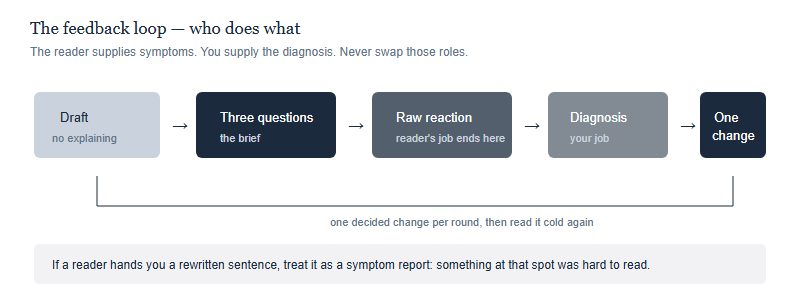
Two rules make this work. Do not explain the piece first. Every sentence of context you supply beforehand is a sentence you have privately added to the draft, and the reader will then read a version that does not exist. And stay quiet while they answer. The urge to say “oh, what I meant was…” is strong; resist it, because if it needs explaining, that is the finding.
Translate the reaction into a fix
Readers describe symptoms in feeling-words. Your job is to convert those into a structural cause, because “make it less boring” is not an instruction anyone can act on. This is the conversion table we use.
| What the reader says | Usual underlying cause | The fix to try first |
|---|---|---|
| “It's a bit boring.” | Nothing is at stake yet — you have described without claiming | Move your arguable claim into the first two sentences |
| “I got a bit lost here.” | A missing logical step, or an unexplained term or name | Add the one clause the reader needs — then cut its cost elsewhere |
| “It's good but I don't know what it's about.” | Two competing claims fighting inside one short piece | Delete the weaker one entirely; do not try to reconcile them |
| “I don't really buy that.” | A generalisation with no specific evidence attached | Replace the assertion with the concrete detail that made you believe it |
| “The ending felt sudden.” | You stopped at the claim without stating its consequence | Add one sentence on what follows if you are right |
| “It sounds like an essay.” | Hedging, formal connectives, no first-person judgement | Cut “furthermore” and “it can be argued that”; commit to the verb |
One warning about the middle column: it is a hypothesis, not a rule. Test the fix, then re-read cold. If the symptom persists, the cause was something else.
Who to ask — and what each reader is good for
Different readers are calibrated instruments for different problems. Asking the wrong reader the wrong question produces the confident, wrong advice that does the most damage.
| Reader | Genuinely good at | Do not ask them for |
|---|---|---|
| A peer in your year | Where attention dropped; whether the voice sounds like you | Judgements about what “wins” — they are guessing too |
| A subject teacher (for a STEM or civics topic) | Whether your facts and mechanisms are right | Structure — they will often want completeness over argument |
| An English teacher | Structure, clarity, whether the claim is arguable | Line-editing your voice into standard school register |
| A parent or family member | Whether the piece is comprehensible to a non-specialist | Topic choice — the pull towards “impressive” subjects is strong |
| Someone outside your school entirely | Whether local context lands without insider knowledge | Nothing — this is the most under-used reader you have |
That last row deserves emphasis for students writing about life in China for a general international readership. A classmate shares all your assumptions and will not notice what you failed to explain; an outside reader notices immediately. One outside reader, briefed with the three questions, is worth several inside ones.
Questions about the contests?
Scan the WeChat QR code — we help with contest registration, one-on-one topic coaching, and full guidance to the deadline.
Scan the WeChat QR code

What to decline — and when to stop listening
You are not obliged to act on feedback, and a piece revised by consensus reads like it. Sort every comment on two axes: is it about the reader's experience or their preferences, and is it specific or vague?
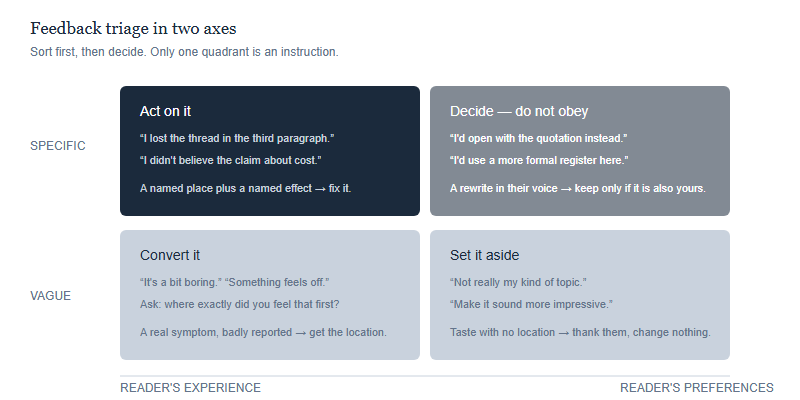
Three kinds of feedback are worth actively refusing. The voice-flattening edit, where a well-meaning reader replaces your phrasing with the register they were taught — take the diagnosis (“this sentence is hard to follow”) and reject the prescription. The impressiveness push, usually “add a statistic” or “mention a bigger issue,” which trades a specific piece for a generic one. And the late structural rethink: a genuinely good idea arriving 24 hours before a deadline is not a good idea, because a half-executed restructure reads worse than a modest piece finished properly.
Which brings up timing. Set a feedback stop — a point after which you accept no new input except typo corrections. Twenty-four hours before submission is a reasonable default; for a weekly Summer Reading entry, closing the input window a full day before the Friday cut-off leaves time to sit with the piece. Then work only on your own final read. If you want a repeatable sequence for that last solo pass, use it alongside the contest calendar so the stop lands on a real date rather than a vague intention, and confirm the closing time on the official Learning Network page — the New York to Beijing gap means you should convert the published closing time to local time before you plan around it.
A last note from our own drafting work, de-identified and per Hanlin, with results varying and nothing here predictable: among students we have supported who have taken Honorable Mentions in the Summer Reading Contest, the common pattern in feedback rounds was restraint. One decided change per round, and a firm stop before the deadline — rather than a draft carrying everyone's suggestions at once. If you are new to the contests and want the map before the method, start with our overview of the Learning Network writing contests.
Frequently asked questions
How many readers should I ask?
Two or three, briefed with the same three questions. More readers produce contradictory taste comments, not better diagnosis.
What if two readers disagree?
Look for the shared symptom rather than the shared solution. If both stalled in the same place, that place is the problem regardless of their fixes.
Should I show a draft to my English teacher?
Yes, for structure and whether the claim is arguable. Ask them not to line-edit your voice into standard school register.
When should I stop taking feedback?
Roughly 24 hours before the deadline. After that, accept only typo corrections — late restructures usually finish worse than the original.
This is an independent guide operated by Hanlin Education for China-based international-school students. We are not affiliated with, endorsed by, or sponsored by The New York Times Company or its Learning Network. Contest rules, word and character limits, eligibility and deadlines are set by the Learning Network and change from year to year — confirm current details on nytimes.com/learning before you enter. Any error reported to our editorial desk is corrected within 7 working days.