A crowded topic is not a disqualifier. What sinks most entries about artificial intelligence, climate or phone bans is not the subject but the frame: the same opening move, the same two examples, the same closing sentence. This guide gives you a diagnostic for spotting that pattern in your own draft, three narrowing moves that produce a claim only you can evidence, and a rule for when to walk away from the idea entirely.
A crowded subject is not the problem. A crowded frame is.
Every season, a handful of subjects absorb a large share of student writing. You already know which ones they are, because you have heard three classmates announce the same plan. The instinct that follows is usually wrong: students conclude the subject is “taken” and either abandon a topic they actually care about, or push on with a draft that quietly reads like everyone else's.
Popularity alone does not disqualify a subject. Some contests do restrict subject matter, however, so check what the announcement for the contest you are entering actually allows. The announcements post the prompt, the rules and, in most years, a short note on what the editors are looking for, plus links to previously published student work. The exact wording changes from contest to contest and from year to year, so read the page for the contest you are entering rather than a summary — confirm current details on nytimes.com/learning. If you are still deciding which contest suits the idea at all, start with our overview of what the NYT Learning Network writing contests are.
We cannot tell you how the Learning Network's readers work internally, and no honest guide can. What we can tell you, from our own editing of drafts by students at China-based international schools, is where the repetition actually lives. Large numbers of students independently choose the same altitude. They write about “AI in education” rather than about one afternoon in one classroom. They write about “climate anxiety” rather than about the recycling bins in one building. The subject is shared; the altitude is what makes the drafts interchangeable.
This matters because altitude is fixable in a single revision, and subject choice usually is not. Changing your subject means starting over and losing whatever you already know. Changing your altitude means keeping the subject and moving the camera closer.
Four sentences that mark a draft as the five-hundredth on its subject
Read your own draft looking for these four patterns. None of them is forbidden, and skilled writers use all of them. The problem is that in a crowded field they arrive at the reader pre-worn.
- The definitional opener. “Artificial intelligence has transformed the way we live and learn.” This sentence starts at the level everyone already shares, which means it carries no information. The swap: open on the smallest concrete thing you can see — a rule, a room, a date, a person doing something. Our guide to the contests lists which forms reward that move most.
- The both-sides pivot. “While some argue that phones should be banned, others believe students need them.” This looks balanced but outsources your thinking to two invented camps. The swap: name a real disagreement you have actually watched happen, between people with names and reasons.
- The unowned statistic. “Studies show that 70 percent of students feel overwhelmed.” A number without an owner, a date and a population is not evidence; it is decoration. The swap: either attribute it fully or cut it. Any figure you keep, you must be able to trace to a source you have actually opened.
- The universal close. “Only time will tell.” “We must act now, before it is too late.” These cost the writer nothing, which is exactly why they cluster. The swap: end on the specific thing that would have to change, and who would have to give something up for it.
If three of the four appear in your draft, the subject is not your problem. Your draft is currently a summary of the public conversation, and the public conversation is the one thing the reader already has.
Three moves that narrow a subject into a claim
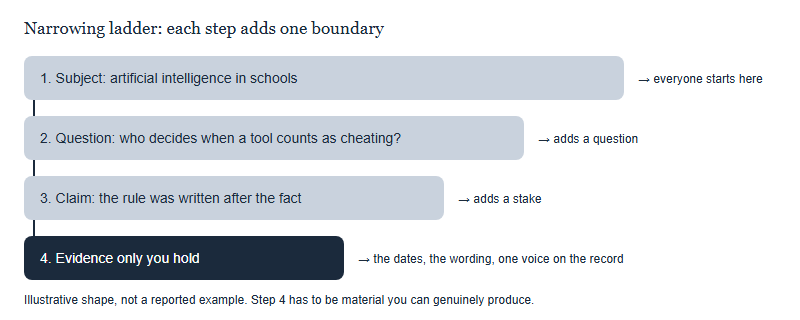
Narrowing is not the same as “making it personal.” A narrow claim can be entirely about other people. What narrowing does is add boundaries until the sentence could only have been written by someone standing where you are standing.
Move 1 — add a place and a time. Take your working sentence and force a location and a date into it. “AI is changing how schools assess writing” becomes “our English department wrote its AI rule in the week after the first accusation.” The second version is smaller, and it is checkable, and it is the only one of the two that could be wrong — which is what makes it worth reading.
Move 2 — name who loses. A claim that costs nobody anything is a claim everybody holds. Ask: if I am right, who has to change, and what do they give up? If the answer is “everyone should care more,” you have a sentiment, not a claim. If the answer is “the department has to admit the rule was written after the fact,” you have an argument with an edge.
Move 3 — anchor to material you can actually produce. Before you commit, list the evidence on hand: what you saw, what document you can quote, whom you can ask. This is the move most drafts skip, and it is the one that decides whether you finish. Access is not automatically local or personal — it might be a school notice, a bilingual source your competition cannot read, a coach's explanation, a number your own club collected. It just has to be yours, and it has to exist before you start writing.
Worked narrowings, subject by subject
The table below shows the shape of the move on four subjects that crowd every season. Read the right-hand columns as illustrations of structure, not as reported facts: the claims are invented to show the pattern, and the material has to be yours before you write a word of it.
Questions about the contests?
Scan the WeChat QR code — we help with contest registration, one-on-one topic coaching, and full guidance to the deadline.
Scan the WeChat QR code

| Crowded subject | The frame most drafts use | A narrower claim you could evidence | What you would need on hand |
|---|---|---|---|
| AI in schools | “AI is changing education and schools must adapt.” | Our department wrote its AI rule after the first accusation, not before it. | The two versions of the rule, the dates, one teacher willing to be quoted |
| Climate | “Climate change is the defining crisis of our generation.” | The recycling scheme in our building sorts nothing after collection. | What you watched at the bins, the building notice, one resident's account |
| Phone bans | “Phones distract students, so schools should ban them.” | The ban moved the problem somewhere nobody was counting. | Two weeks of your own observation, the policy text, what staff say happens |
| Exam pressure | “Students today are under too much pressure.” | Our school counts mock scores twice: once for us, once for a display board. | Both documents, how the board is displayed, what one Year 13 says changed |
Notice what does not change across the rows: the subject. You are not abandoning AI or climate. You are refusing to argue at the altitude where everyone agrees with you, because agreement is where writing goes to die.
Three tests, then a decision
Before you spend a week on a draft, run these in order. Each takes minutes, and each has a clean pass-or-fail answer.
- The ownership test. Point to one sentence in your draft that no other entrant could have written. Not a sentence phrased distinctively — a sentence containing information they do not have. If you cannot find one, you have a subject, not an entry.
- The substitution test. Swap your school, your city and your year group for someone else's. Read it again. If nothing in the draft breaks, nothing in the draft was yours.
- The deletion test. Cut the two facts you quote most often — usually the ones you found first, from the most obvious source. Is there still an argument standing? If the whole piece collapses, you were assembling, not arguing.
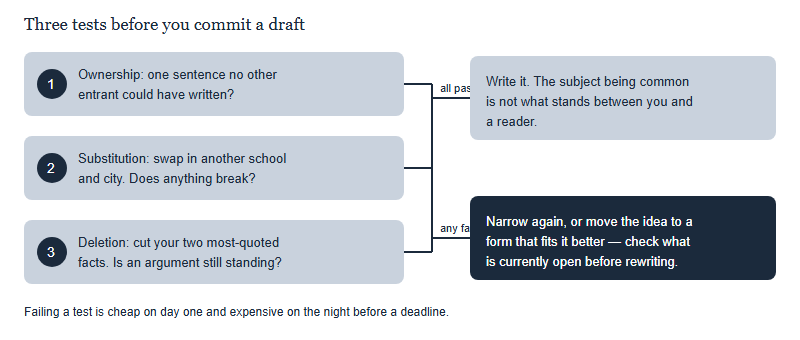
When should you actually walk away? Three situations. First, when the only distinctive material belongs to someone who has not agreed to be written about. Second, when the material exists but you cannot verify it — a rumour about your school is not evidence, however well sourced it feels. Third, when the idea is real but the form is wrong: an argument that only works as a letter to a named recipient is not an essay with a missing addressee, and the Open Letters Contest is a genuinely different container. Before you rewrite, check the contest calendar to see what is actually open, and confirm the current dates on the official Learning Network page — deadlines shift year to year.
A 45-minute audit before you commit
Set a timer. This audit is deliberately short, because its job is to stop you spending a week on a draft that was never going to survive.
- Minutes 0–10 — write the claim in one sentence. One sentence, no semicolons. If it needs two sentences, you have two ideas and have not chosen.
- Minutes 10–25 — list your evidence. Three bullets, each naming a specific thing: a document you can quote, something you watched, a person you can ask. Anything you would have to search for later goes in a separate list called “hoping.”
- Minutes 25–35 — run the three tests. Ownership, substitution, deletion. Write pass or fail beside each. Do not argue with yourself.
- Minutes 35–45 — check the container. Open the announcement for the contest you intend to enter. Confirm the word limit, the eligibility wording, whether it asks for sources and how, and the deadline in your own time zone. This site runs on UTC and yours may not; the only figure that counts is the one on nytimes.com/learning today.
One last discipline, and it is the one students skip: every number that survives into your final draft needs an owner, a date and a population. If you cannot say who produced the figure and when, cut it. In a crowded field, an unsourced statistic is not just a weak sentence — it is the single fastest way to make a reader stop trusting the rest of a piece that may be entirely true.
Frequently asked questions
Will a popular topic hurt my chances?
Popularity alone does not disqualify a subject, though some contests do restrict subject matter, so check the announcement. What clusters is the framing, not the topic, and framing is something you can change in one revision.
Is an obscure topic safer?
Only if you can evidence it. An obscure subject with no material behind it reads thinner than a common one carrying a first-hand claim.
How do I know which topics are crowded this year?
You cannot know precisely. Read the current contest page and its past winners, then check what is open before you commit a draft.
Can I enter the same narrowed claim in two contests?
Sometimes, but each contest sets its own form and rules. Confirm on the official Learning Network page before you reuse anything.
This is an independent guide operated by Hanlin Education for China-based international-school students. It is not affiliated with, endorsed by, or sponsored by The New York Times Company or its Learning Network. Contest rules, word limits, eligibility and deadlines change from year to year — confirm current details on nytimes.com/learning before you enter. Errors are corrected within 7 working days of being reported.