A recognised entry in a NYT Learning Network contest does one job inside an application: it corroborates. An admissions reader checks it against your transcript, your activity list, your essays and your teacher's letter, and the file becomes believable when those four agree. This guide covers which slot the result belongs in, how to word the line accurately, and what the result cannot do.
The short answer: a result is a cross-check, not a headline
Two other questions get asked more often than this one, and both are answered elsewhere on this site: whether entering is worth the hours, and how to move material from a contest entry into a personal statement. This article is about the narrower, more practical question students ask in October — I have a result; where does it go, and what does it actually do once it is there?
Start from how the file is read. An application is a set of claims about a person, arriving from several directions: a school produces the transcript, you produce the activity list and the essays, a teacher produces the letter. None of those is independently decisive. What makes a file credible is that the claims corroborate one another — the strong English grade, the sustained writing activity, the essays that sound like a writer, and the teacher who can describe watching you revise. Several results across different forms — a reported piece, a review, an argument — corroborate range rather than luck.
A contest result is a small, external, dated piece of evidence dropped into that set. It carries weight precisely because you did not award it to yourself. That is also the limit of what it does: it confirms a claim you are already making, rather than substituting for one you are not.
Four slots, and which one your result belongs in
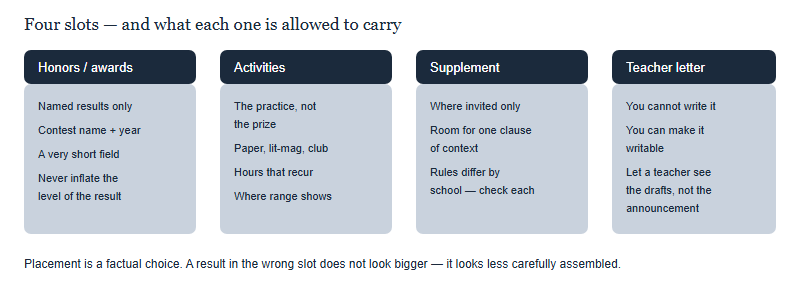
Placement is a factual decision, not a marketing one. Putting a result in the wrong slot does not make it look bigger; it makes the file look less carefully assembled.
- The honors or awards field. This is for named results only: a win, a runner-up placing, a finalist listing, an honourable mention. The field on most application platforms is extremely short — count your characters against the live form, not against a number quoted in any guide, including this one.
- The activities list. This is where the practice goes, not the prize. If you write weekly, edit the school paper, run a lit-mag or keep a contest habit across a year, that recurring commitment belongs here with its real hours. A single award floating in an activity list with no writing life around it reads as a one-off.
- A writing supplement, portfolio or additional-information field. Only where a school actually invites it. This is the one place you have room to say in a clause what the contest is, which matters because a reader outside the US school system may not know it. Requirements differ by university and change; check each school's own instructions.
- Your teacher's letter. You cannot write this, but you can make it writable. A teacher who saw three drafts, an argument you abandoned and the revision that fixed it can say something specific. A teacher who learns about the result in an email in November cannot.
How to write the one line
You will have room for a phrase, not a sentence. Three principles: name the contest exactly as the organiser names it; state the result exactly as it was awarded; and, if characters allow, add the one clause a reader outside the US school system needs in order to place it. Skip adjectives entirely. “Prestigious” and “international” are the two words most likely to make a reader discount the line, because they are the words applicants add when the specifics are thin.
| Weak line | Stronger line | Why it reads better | Slot |
|---|---|---|---|
| Won a New York Times writing competition | Honorable Mention, NYT Learning Network Summer Reading Contest, 2026 | Names the specific contest and the actual result; nothing is inflated, so nothing needs defending | Honors |
| Prestigious international essay award | Runner-up, NYT Learning Network Student Editorial Contest, 2026 | Adjectives removed; the reader forms their own judgement from the facts | Honors |
| Writer | Entered four Learning Network contests across the school year; one entry recognised | Describes a practice with real numbers you can stand behind, rather than a title | Activities |
| Top writer in my school | Editor, school paper; wrote and revised weekly contest entries for one academic year | Replaces a ranking nobody published with a commitment a teacher can confirm | Activities |
Two accuracy rules that matter more than anything stylistic. First, do not upgrade the result: an honourable mention described as a win is a factual error sitting inside a file whose entire value comes from everything checking out. Second, do not quote selection rates, entry totals or “top N per cent” figures unless the organiser published that figure for that contest and year and you can point to where. If a guide anywhere hands you an admission statistic for a writing contest, ask where the number came from before you repeat it.
What the result is checked against
Cross-validation is not an abstraction; it is a set of specific comparisons a reader makes almost automatically. Knowing them tells you what to build in the year before you apply.
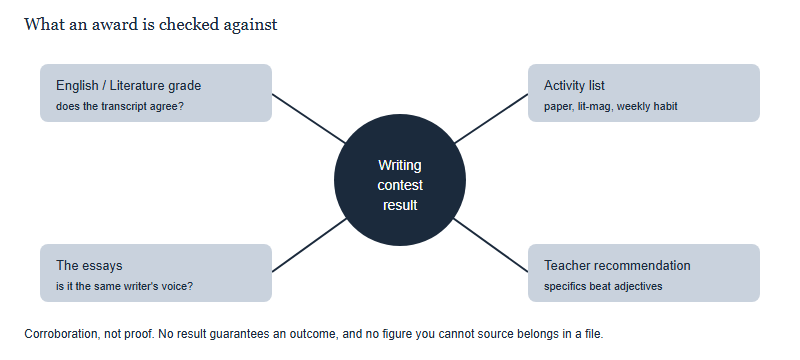
The transcript. A writing result beside a strong English or Literature record is unremarkable in the best sense: two independent sources saying the same thing. Beside a weak one, it is not fatal, but it becomes a question. If there is a genuine reason for the gap — a language transition, a school change, a year of illness — the file should say so somewhere honest, briefly and without pleading.
The activity list. Recurrence is what converts a result from a lucky afternoon into a practice. One award, no writing around it, reads as an event. The same award beside a year of entries, an editing role and a habit reads as the visible tip of something ongoing. Planning that year in advance is why the contest calendar is worth reading in September rather than in March.
The essays. This is the strongest corroboration available, and the one students underrate: the personal statement should sound like it was written by the person who wrote the contest entry. Not the same subject, not the same sentences — the same instincts about detail, rhythm and where to stop. This is also why entering changes an application even when nothing is recognised. You cannot fake a writing voice into existence in October; you can build one across a year of short deadlines.
Questions about the contests?
Scan the WeChat QR code — we help with contest registration, one-on-one topic coaching, and full guidance to the deadline.
Scan the WeChat QR code

The recommendation. A teacher who read your drafts can write a paragraph nobody else can supply: what you were trying to do, what went wrong, what you did about it. The practical implication is a scheduling one — show a teacher the work while it is unfinished, not the result once it is announced.
What a non-winning entry is still worth
Most entries in a large field are not recognised. That is a description of arithmetic, not a comment on your writing, and it does not make the work wasted. Four things you keep regardless:
- Finished work at a real word limit. There is no substitute for having actually cut a piece to a fixed count under a fixed deadline. Application prompts have limits too, and students who have done this before arrive with the skill already built.
- Material. The narrowed claim, the interview, the observation you spent a week getting — none of that disappears when the results post. It resurfaces in supplements and essays, usually in a better form.
- A teacher who watched you work. The letter benefits from the process, not the outcome.
- A defensible answer to a common interview question. “Tell me about something you wrote” is easier to answer well when the honest answer includes a piece you revised four times and did not place with.
Per our own records, students we have worked with have earned recognition in Learning Network contests, including an honourable mention in the Summer Reading Contest. We publish that as our own observation rather than as a verified statistic, and we do not publish student-to-university pairings. If you want the wider picture of which contests exist and which suit your writing, start from our guide to the Learning Network writing contests; if you want a form where an argument is addressed to a named recipient, the Open Letters Contest is a useful place to begin.
The limits, stated plainly
No competition result guarantees an admission outcome, and any guide that implies otherwise is selling something. What a result can do is corroborate — it tells a reader that an outside party, on a set date, judged your writing worth publishing or naming, and that judgement sits alongside everything else in the file and agrees with it.
Three things to avoid on principle. Do not describe a result as more than it was. Do not attach numbers you cannot source to it, whether they come from an organiser, a consultant or a forum. And do not build a file in which the award is the only claim doing work — a single external result surrounded by nothing is the one configuration where writing recognition genuinely does very little. Everything above is about the surrounding structure, because that is the part you control. Deadlines, eligibility and contest names shift from year to year; confirm the current details on nytimes.com/learning before you write any of them into an application.
Frequently asked questions
Where should a contest result go on an application?
A named result belongs in the honors or awards field. The writing practice around it belongs in activities, not in the awards line.
Does an honorable mention count?
Yes, if you name it accurately. Describing it as a win is a factual error in a file whose value depends on everything checking out.
What does the result actually do for a reader?
It corroborates. An award is checked against your English grade, your activity list, your essays and your teacher letter.
Is it worth entering if I do not place?
Often yes. You end with finished work at a real word limit, material for essays, and a teacher who watched you revise.
This is an independent guide operated by Hanlin Education for China-based international-school students. It is not affiliated with, endorsed by, or sponsored by The New York Times Company or its Learning Network. Contest rules, word limits, eligibility and deadlines change from year to year — confirm current details on nytimes.com/learning before you enter. Errors are corrected within 7 working days of being reported.