NYT Student Writing Leads: Choose an Opening That Creates a Reason to Read
The first sentence of a New York Times student contest entry does not need to be clever. It needs to create a reason to read the second sentence. This article compares how three opening strategies—scene, summary, and question—function within the strict word limits of two popular NYT contests, using worked teaching illustrations checked against the official evaluation criteria.
What the Contest Actually Evaluates
The NYT Summer Reading Contest, according to the 2026 source materials, scores entries on five dimensions: originality, personal connection, close reading of the source material, public significance, and language/polish. The 100-word Personal Narrative Contest applies similar standards. No source document specifies a required lead structure, a word-ratio formula, or a maximum sentence length for openings. The constraints are the total word limits themselves: 100 words for personal narrative, approximately 250 words for summer reading, 450 for editorials, 400 for reviews, and 500 for open letters.
Three Lead Strategies and Where They Fit
Below are three opening approaches, each with a teaching illustration showing how it deploys the limited word budget. These are invented craft examples, labeled as such, not winning entries or official models.
Strategy 1: The In-Media-Res Scene Lead
Teaching Illustration—100-Word Personal Narrative format:
“The rice cooker hissed at 6:47 a.m., same as every morning. I stood on a stool to reach it, because my grandmother still refuses to buy a smaller one. ‘You will grow,’ she says, though I am seventeen. That hissing sound is why I applied to engineering programs instead of the art schools she thinks I want.”
Why this fits: The scene lead spends 29 words on sensory detail before stating the essay’s subject. In the 100-word contest, this is expensive. It works if the scene itself carries the personal connection and public significance the judges seek—here, the intergenerational tension between filial obligation and individual ambition. The risk: if the scene does not clearly connect to the essay’s argument, the word count consumes the space needed for that connection.
Strategy 2: The Direct Summary Lead
Teaching Illustration—250-Word Summer Reading format, responding to a NYT article about urban heat islands:
“Cities are not failed nature. They are successful geology with different rules. After reading ‘The Life and Death of the Industrial Canal,’ I understood why my neighborhood in Chongqing floods differently than the maps predict—and why that matters for who gets to move when the water rises.”
Why this fits: The direct summary lead states the thesis immediately. Sources do not support any claim that this approach is “lazy” or ineffective. In a 250-word summer reading entry, it preserves words for close reading of the source material and public significance. The trade-off: it requires the claim to be genuinely interesting without scenic support. This lead works when the writer’s interpretation of the source is itself the hook.
Strategy 3: The Rhetorical Question Lead
Teaching Illustration—250-Word Summer Reading format, responding to a NYT article about name trends:
“What makes a name ‘real’? The NYT article on unconventional baby names argues authenticity is ‘in,’ but my name—given by my grandfather from a poem he misremembered—suggests authenticity is something we perform backward, after the fact.”
Why this fits: The question lead engages the reader’s own thinking. It is not universally weak or strong. Its effectiveness depends on whether the question is answered substantively in the remaining words. In this illustration, the question is answered by the second sentence, which connects personal experience to the source material. The danger: an unanswered question that reads as a gimmick, consuming words without advancing the entry.
A Contrasting Case: Where a Scene Lead Fails
Teaching Illustration—Failed version, 100-Word Personal Narrative:
“The sun rose over the mountains, painting the sky in hues of orange and pink. Birds chirped their morning songs. I woke up and thought about my identity.”
Why this fails: The scene is generic—no specific sensory detail ties to a particular experience. The transition to “I thought about my identity” is abstract, not earned. The entry has spent 24 words without establishing personal connection or public significance. In a 100-word limit, this leaves insufficient space to recover. The failure is not that scene leads are bad; it is that this scene does not perform the work the evaluation requires.
Diagnostic Application: Matching Lead to Contest Format
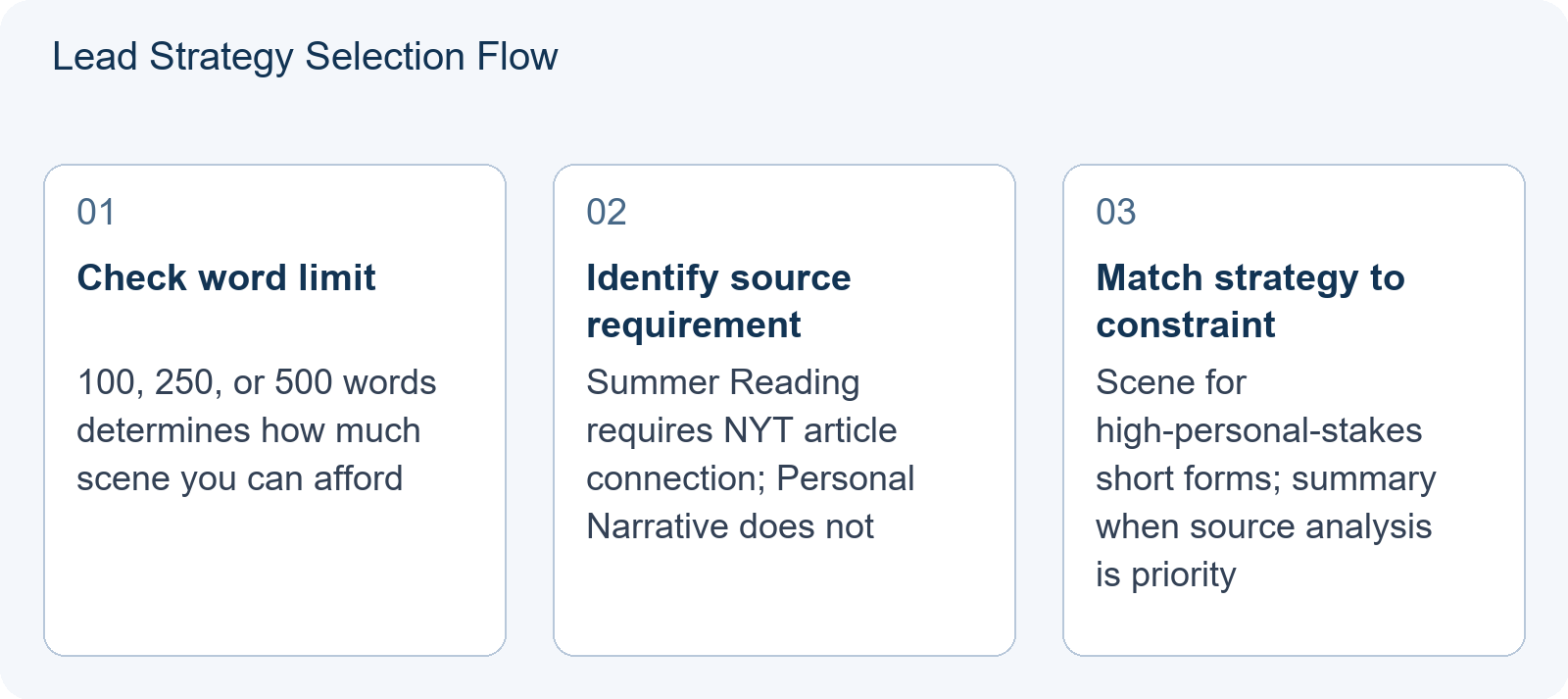
Consider three actual NYT contest constraints and which lead strategy aligns:
| Contest | Word Limit | Source Material Required? | Lead Strategy Fit |
|---|---|---|---|
| Personal Narrative | 100 words | No | Scene or summary; question risks word waste |
| Summer Reading | ~250 words | Yes—NYT article | Summary or question; scene must directly source-connect |
| Open Letter | 500 words | No | Any strategy; more room to develop scene |
The diagnostic question is not “which lead is best?” but “which lead does the most work within this specific constraint?”
What the Diagnostic Result Means for Your Next Step
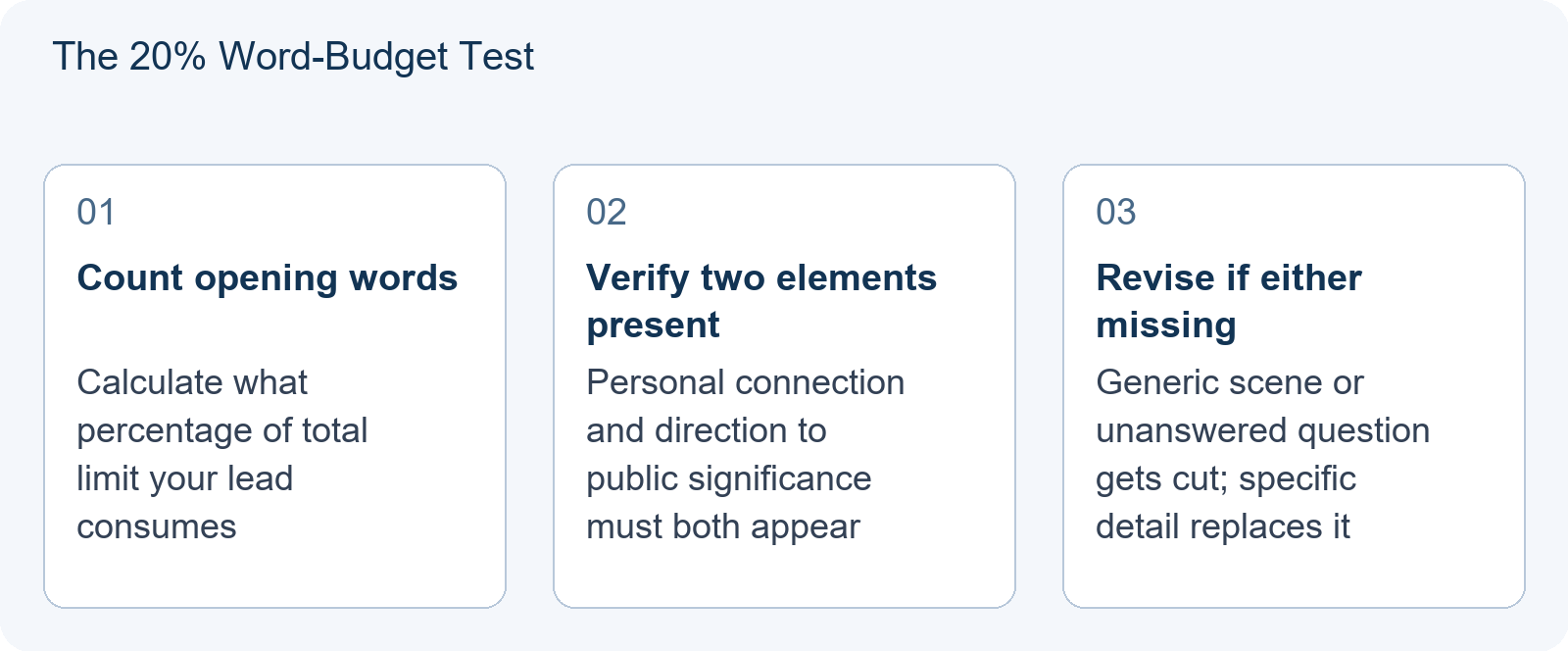
If your draft opening consumes more than 20% of the word limit without establishing both personal connection and a clear direction toward public significance, revision is needed. Useful feedback addresses: (1) whether the opening sentence could only have been written by you, and (2) whether a reader who has not seen your source material (for contests requiring one) could still follow the argument.
Related Preparation Resources
For techniques on cutting repetition without losing voice, see NYT Student Writing Revision: Cutting Repetition Without Losing Your Voice. For sensory detail specifically, see NYT Student Writing Sensory Detail: Replacing a Vague Impression With a Specific Scene. For the changed 2027 Summer Reading format with only three submission rounds, see NYT Summer Reading Contest 2027: How the Three-Round Format Changes Your Preparation Strategy.
Diagnostic Exercise: The “So What?” Test for Your Lead
The existing article explains why a lead must create a reason to read. But students often struggle with how to verify that their chosen strategy actually performs that work within the tight word limits of NYT contests. A common failure mode is not a bad sentence, but a good sentence that fails to connect to the essay’s core argument. To address this gap, we introduce a practical diagnostic method called the “So What?” Test. This is a self-editing tool, not an official scoring rubric, designed to help you determine if your opening earns its place in the first 10-20% of your word budget.
How the “So What?” Test Works
After writing your lead, immediately ask yourself: “If I deleted this entire paragraph and started with my second paragraph, would the reader lose any essential context or emotional hook?” If the answer is no, your lead is decorative rather than functional. In short-form contests like the 100-word Personal Narrative or the ~250-word Summer Reading entry, every sentence must advance either the personal connection or the public significance. A lead that merely sets a mood without advancing the argument consumes precious space without earning it.
Let us apply this test to the three strategies previously discussed, using new teaching illustrations to show how the same approach can succeed or fail based on its connection to the thesis.
Questions about the contests?
Scan the WeChat QR code — we help with contest registration, one-on-one topic coaching, and full guidance to the deadline.
Scan the WeChat QR code

Applying the Test to Scene Leads
Teaching Illustration—Weak Scene Lead (100-Word Format):
“The rain tapped against the windowpane, a rhythmic drumming that matched my heartbeat. I watched the droplets race down the glass, thinking about how time passes so quickly. It made me wonder if I was ready for college.”
Diagnostic Result: Fail. The “So What?” test reveals that deleting this paragraph loses nothing essential. The imagery is generic; the transition to “thinking about how time passes” is abstract. The reader does not need the rain to understand the anxiety about college. The scene does not perform the work of establishing a unique personal connection. A stronger version would tie the specific sensory detail directly to the argument, such as using the sound of the rain to trigger a specific memory related to the decision being made.
Teaching Illustration—Strong Scene Lead (100-Word Format):
“My father’s hands shook when he handed me the acceptance letter, not from age, but from fear. He had never left our village. That tremor is why I study structural engineering—to build bridges he could cross safely.”
Diagnostic Result: Pass. Deleting this lead destroys the essay. The shaking hands are not just atmosphere; they are the evidence for the thesis. The scene establishes the personal connection (father’s fear) and the public significance (safety/infrastructure) in one motion. The “So What?” test confirms that the scene is load-bearing.
Applying the Test to Summary Leads
Teaching Illustration—Weak Summary Lead (250-Word Format):
“This week, I read an interesting article about climate change. It talked about rising sea levels and how cities need to adapt. This is important because many people live near coasts.”
Diagnostic Result: Fail. The summary is vague and lacks a specific angle. The “So What?” test shows that the reader gains no unique insight from this opening. It reads like a book report introduction. In a contest requiring close reading of source material, a weak summary wastes words that should be used for specific analysis of the text.
Teaching Illustration—Strong Summary Lead (250-Word Format):
“The NYT article ‘The Invisible Flood’ argues that zoning laws, not just water levels, determine who drowns. My neighborhood’s recent rezoning proves his point: we are building luxury condos where the flood maps say ‘no.’”
Diagnostic Result: Pass. The lead states a specific interpretation of the source material and connects it immediately to a local example. Deleting this lead removes the argumentative framework for the rest of the piece. The summary is efficient because it carries the weight of both the source engagement and the personal/public connection.
Applying the Test to Question Leads
Teaching Illustration—Weak Question Lead (250-Word Format):
“Have you ever wondered what makes a person truly happy? Is it money, love, or success? These are big questions that everyone asks.”
Diagnostic Result: Fail. This is a cliché rhetorical question. The “So What?” test reveals that the question is too broad to be answered substantively in 250 words. It consumes space without narrowing the focus. Judges look for originality; a generic question signals a lack of specific thought.
Teaching Illustration—Strong Question Lead (250-Word Format):
“Can an algorithm write a better eulogy than a grieving daughter? The NYT piece on AI grief bots suggests yes, but my experience writing my grandmother’s obituary says otherwise.”
Diagnostic Result: Pass. The question is specific, provocative, and directly tied to the source material. It sets up a clear conflict (AI vs. human authenticity) that the rest of the essay will resolve. The question is not a gimmick; it is the thesis statement in interrogative form.
Next Practice Task: The Deletion Draft
To internalize this diagnostic, try the “Deletion Draft” exercise. Write your entry normally. Then, create a copy where you delete the entire first paragraph. Read the remaining text. Does it still make sense? Does it still have energy? If the remaining text feels abrupt or confusing, your lead was necessary. If the remaining text flows smoothly and retains all key arguments, your lead was likely redundant. For the next draft, rewrite the lead to ensure it contains at least one specific detail (sensory, factual, or analytical) that cannot be found elsewhere in the essay. This ensures your opening creates a unique reason to read the second sentence.
Frequently Asked Questions
Does the NYT specify what kind of lead wins?
No. The published evaluation criteria for the Summer Reading Contest list five dimensions—originality, personal connection, close reading, public significance, and language/polish—without mentioning lead structure. No source document prescribes opening formulas.
Can I use a rhetorical question in a 100-word personal narrative?
You can, but the word limit is strict. A question that is not immediately answered consumes scarce space. The teaching illustrations above show a question lead working in the 250-word format where more development room exists.
Is a scene opening too risky for contest entries?
A scene opening is risky when it is generic or when its connection to the entry’s argument is delayed beyond what the word limit allows. A specific, immediately purposeful scene can work in any format. The contrasting case above shows failure from genericity, not from the scene strategy itself.