Judges read thousands of competent entries. Competent is not the problem — interchangeable is. Voice is what makes a reader able to tell your piece from the one before it, and it is not personality sprinkled on afterwards. It is four decisions you make sentence by sentence: your words, your rhythm, your stance, and what you choose to notice.
Voice is four decisions, not a mood
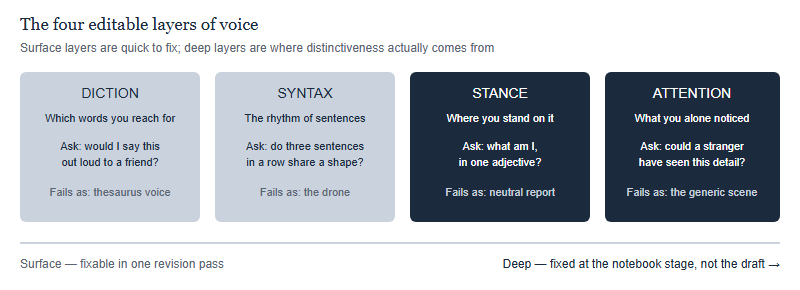
Most advice about voice is unusable because it describes a result rather than a mechanism. “Be authentic” tells you nothing you can act on at 11pm with a draft open. It helps far more to treat voice as four separate, editable choices.
Diction — which words you reach for. Every writer has a default register. Some reach for obtain, others for get. Neither is better, but a piece that mixes registers at random has no voice, and a piece written entirely in borrowed formal vocabulary has someone else’s.
Syntax — the rhythm of your sentences. Sentence length is the most underused instrument students have. Uniform sentences produce a drone regardless of how good the content is. Variation — particularly a short sentence after a long one — is most of what readers experience as confidence.
Stance — where you are standing relative to your material. Amused, angry, unsure, forensic, protective. Stance is a position, and most flat writing is flat because the writer never took one. A piece can be uncertain and still have stance; what it cannot be is absent.
Attention — what you notice that others would not. This is the deepest layer and the hardest to fake. Two students at the same event write different pieces because they looked at different things. Attention is voice in its purest form, which is why the fastest route to a distinctive piece is usually a more specific observation rather than a fancier sentence.
The three ways voice disappears
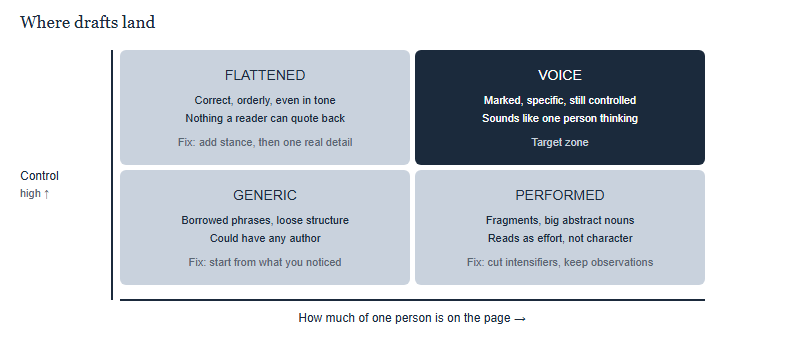
School formal. The most common. Years of academic writing train students into a register built for demonstrating competence: In today’s rapidly developing society, it is undeniable that… This register is designed to sound like everyone, because in an exam that is safe. In a contest it is invisible. The tell is that the first sentence of every paragraph announces what the paragraph will do.
The flattened draft. Prose that is grammatical, orderly, tonally even and entirely unmarked — no preference, no hesitation, no joke, nothing observed that could only have been observed by one person. Readers describe it as smooth and forget it immediately. It often appears when a writer has revised for correctness many times and for character never.
The performance. The overcorrection. Sentence fragments everywhere. Rhetorical questions. A dramatic one-line paragraph. Big abstract nouns doing emotional work. This reads as effort rather than personality, and it is a particular risk in personal narrative, where students sometimes mistake intensity for intimacy.
The useful distinction is between having a voice and doing a voice. The first is a by-product of noticing precisely and taking a position. The second is decoration applied to a piece that has neither.
Worth naming a fourth, quieter failure: the hedged draft. Sentences arrive wrapped in perhaps, it could be argued, in some ways, many people believe. Hedging feels responsible, and in academic work it often is. In a short entry it removes the writer from the page one qualifier at a time, until nobody is home. Genuine uncertainty is a stance and reads as honest; reflexive hedging is the absence of one. The repair is to keep the doubts that are real, state them directly in your own words, and delete the rest.
Questions about the contests?
Scan the WeChat QR code — we help with contest registration, one-on-one topic coaching, and full guidance to the deadline.
Scan the WeChat QR code

Weak to strong: three rewrites
All sentences below are invented for this guide. The point is not that the right-hand versions are prettier — it is that they could only have been written by one person.
| Draft | Layer that failed | Rewrite |
|---|---|---|
| “In today’s modern society, social media has both advantages and disadvantages for teenagers.” | Stance. No position taken, so no reader can disagree — or care. | “I have never once closed an app because I decided to. I close them because the battery dies.” |
| “The film was very interesting and had many meaningful themes that made me think deeply.” | Attention. Nothing was actually looked at; the sentence could describe any film ever made. | “The film spends four minutes watching a man fail to park a car, and it is the only part I still think about.” |
| “It was raining. I was walking. I was thinking about my mother. I felt sad about the argument.” | Syntax. Four sentences of identical length and shape produce a drone that flattens real feeling. | “It rained the whole walk home, and I rehearsed six versions of an apology I already knew I would not give. None of them were true.” |
Voice is calibrated to the form
Voice does not mean the same register everywhere. A contest that asks for argument rewards a different stance from one that asks for a story. Formats, word limits and requirements differ by contest and by season — confirm current details on nytimes.com/learning — but the voice logic is stable:
| Form | Stance that works | Voice risk to watch |
|---|---|---|
| Editorial / argument | Committed and specific; willing to name what you would give up | Debate-club voice — loud claims, borrowed phrasing, no author behind them |
| Personal narrative | Intimate but composed; the older self quietly present | Performance — mistaking intensity for honesty |
| Review / criticism | Judging out loud, with the standard you are judging by made visible | Summary voice — retelling instead of assessing |
| Explanatory and STEM writing | Curious guide; pleasure in the mechanism itself | Textbook voice — accurate, authorless, unreadable |
| Open letters | Addressed and particular; you know who is reading | Public-speech voice — writing past the recipient to an imagined audience |
The open-letter row is the most instructive. A named recipient forces stance automatically, which is why letters so often unlock voice in students whose essays sound anonymous. If that is your problem, our Open Letters Contest guide is a useful place to start; the full range of forms is set out in our overview of the contests.
A five-minute voice audit
Run this on a finished draft, before your final proofread. Each test isolates one layer.
- Read it aloud, standing up. The places you stumble are almost always syntax problems, and the places you get bored are stance problems. This single test catches more than any checklist.
- The attribution test. Cover your name and ask: how many people in my year could have submitted this? If the answer is more than three, the problem is attention, not vocabulary.
- Delete every paragraph’s first sentence. If the paragraph still works, that sentence was signposting — the residue of school-formal register. Most drafts lose two or three this way and immediately sound more like a person.
- Count sentence lengths. Write the word count of each sentence in the margin. Three consecutive numbers within two of each other is a drone; break one deliberately.
- Circle the abstractions. Society, pressure, identity, growth, connection. Each is a place where a specific thing was available and a general word was used instead. Replace one with something you actually saw.
- Find one sentence only you could write. If there is not one, the draft is not finished, whatever its word count. Adding it is usually a matter of restoring an observation you cut for being too small.
Two habits build voice faster than any revision technique. First, keep a running note of things you notice — overheard lines, small physical details, opinions you cannot fully defend. Attention is trainable, and a stocked notebook is the difference between having something to say and having to invent it. Second, read work you admire and ask what the writer is doing, not what they are saying — where they put the short sentence, where they refuse to explain, where they let a detail stand without comment. Then plan which contests to aim at using the season calendar, so you are drafting with time to spare rather than writing to a deadline.
Frequently asked questions
Can I have a strong voice if English is my second language?
Yes. Voice comes from stance and attention, not vocabulary size. Precise, plain sentences carry voice perfectly well.
Is using “I” necessary for voice?
No. Explanatory and critical writing can have strong voice without first person. Stance is what matters, not pronoun.
How do I know if my voice is too much?
If a reader notices the writing before the subject, dial it back. Voice should feel inevitable, not applied.
Should I write differently for different contests?
Adjust register and stance to the form, but not identity. The same person should be recognisable across all your entries.
This is an independent guide operated by Hanlin Education for China-based international-school students. We are not affiliated with, endorsed by, or sponsored by The New York Times Company or its Learning Network. Contest rules, word limits, eligibility and deadlines change each season — confirm current details on nytimes.com/learning before entering. Errors reported to our editorial desk are corrected within 7 working days.