For students preparing for NYT contest Google Docs workflows, understanding the shift toward process transparency is critical. Recent updates, particularly for the Summer Reading Contest, emphasize that judges want to see your thinking evolve. This isn’t just about anti-cheating; it’s about valuing the craft of writing itself.
The Core Requirement: Written Submissions
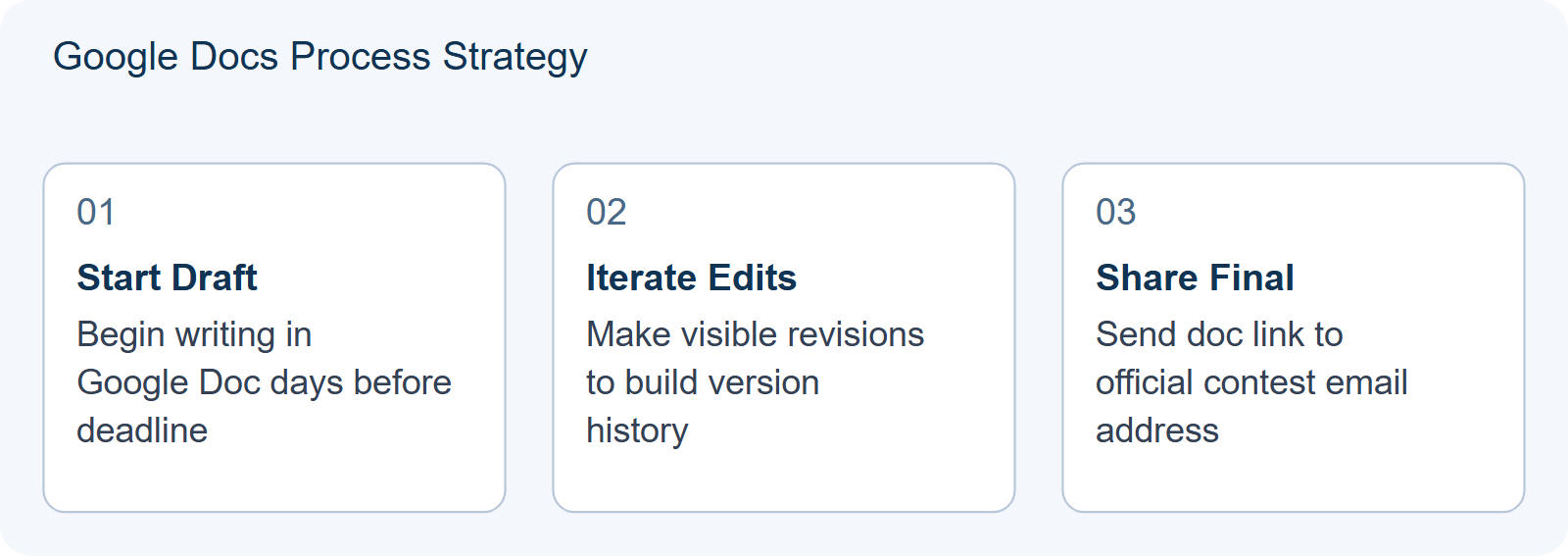
For text-based entries, such as those in the Summer Reading Contest, the New York Times has introduced a specific technical expectation. Students must compose their written submissions from start to finish within a Google Doc. Crucially, you must share this document directly with the designated email address (e.g., studentchallenges@nytimes.com). Why? Because Google Docs provides a version history. This feature allows editors to view every edit, pause, and revision, offering a window into your genuine intellectual journey.
This requirement highlights a broader trend noted in the 2026-2027 contest calendar: creation process documentation is increasingly counted in judging. While specific platform rules may vary by contest type, the principle remains: show your work.
Strategic Preparation for Authenticity
How do you ensure your version history looks like a real writer’s process rather than a last-minute paste? Here is a practical approach:
- Draft Early: Start your document days before the deadline. Let the timestamps reflect a natural progression.
- Edit Visibly: Make small, incremental changes. Delete sentences, rephrase paragraphs, and add comments to yourself if needed.
- Avoid Bulk Pasting: Do not write elsewhere and copy-paste the final draft into the Google Doc. This creates a suspiciously clean history.
If you are unsure about the boundaries of assistance, read our guide on how much help is allowed on a NYT contest entry. It clarifies the line between editing support and ghostwriting.
Beyond Text: Adapting to Other Formats
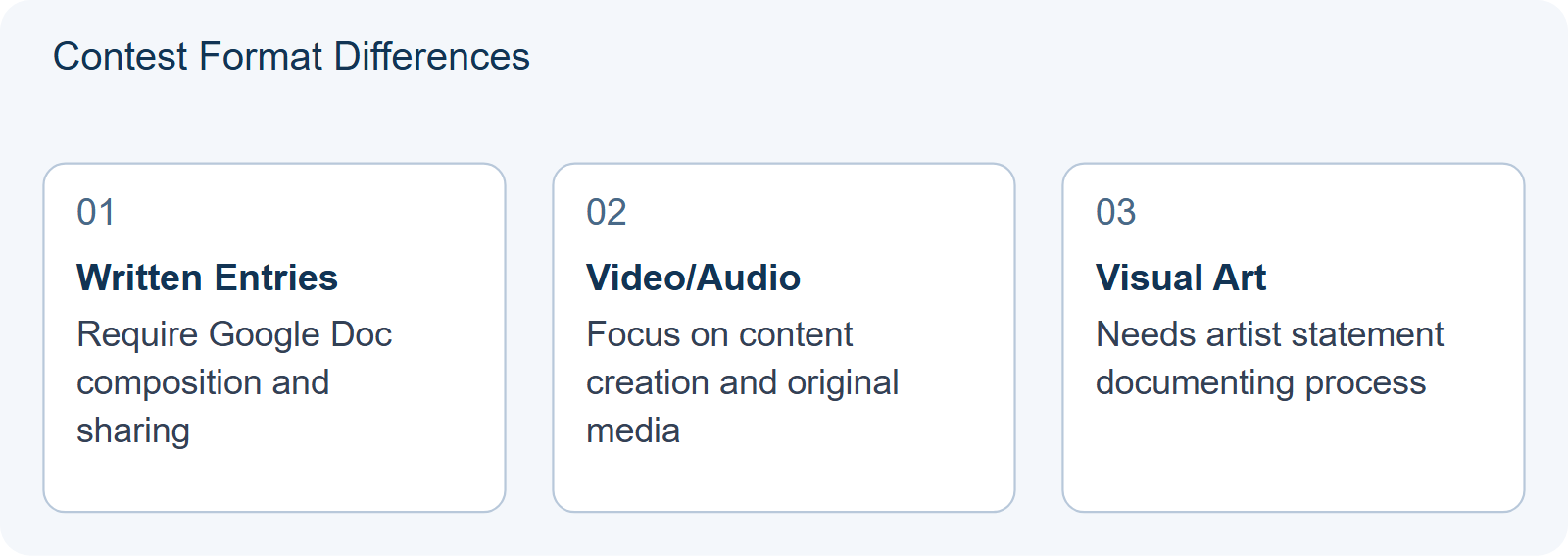
Not all contests follow the same digital footprint rules. For instance, the NYT STEM Interview Video Contest focuses on content creation and interview logistics, while the Audio Stories Podcast Contest emphasizes scripting and audio quality. However, the underlying philosophy of authenticity applies universally. Whether you are writing a memoir or recording a podcast, your process should reflect your own voice and effort.
For visual artists, the NYT Visual Art Contest requires an artist’s statement documenting the creative process. This mirrors the Google Doc version history concept: providing evidence of your original thought and execution.
Common Pitfalls to Avoid
| Pitfall | Consequence | Solution |
|---|---|---|
| Writing in Word then pasting | Empty version history raises red flags | Compose directly in Google Docs |
| Using AI for drafting | Violates zero-tolerance AI bans | Rely on personal research and reflection |
| Ignoring deadlines | Submission rejected regardless of quality | Set internal deadlines 24 hours early |
Remember, the goal is to produce a polished piece that stands up to scrutiny. If you are struggling to structure your argument, consider reviewing the shape of a short contest entry to ensure your logic flows naturally.
Final Thoughts
Adapting to the NYT contest Google Docs workflow is manageable with preparation. By treating the version history as part of your submission, you demonstrate integrity and commitment. This approach not only meets current standards but also builds habits valuable for future academic and professional writing.
Hypothetical Illustration: The “Messy” Draft vs. The Clean Paste
To understand how to apply the advice on maintaining a clear record of your writing, consider this hypothetical scenario involving two students, Alex and Jordan, both preparing for a text-based entry in the Summer Reading Contest. They have identical final drafts, but their preparation methods differ significantly. This example is illustrative only and does not represent real student cases or official judging criteria.
Questions about the contests?
Scan the WeChat QR code — we help with contest registration, one-on-one topic coaching, and full guidance to the deadline.
Scan the WeChat QR code

Alex decides to write the initial draft in a separate word processor because they prefer the interface. Once satisfied with the content, Alex copies the entire text and pastes it into a new Google Doc just hours before submission. The version history shows a single timestamp where the document goes from empty to fully populated. While the writing itself is strong, the digital footprint offers no evidence of revision, editing, or thought evolution. If a judge were to inspect the metadata, the lack of incremental changes might raise questions about whether the work was genuinely developed during the contest period or imported from elsewhere.
In contrast, Jordan opens a blank Google Doc three days before the deadline. Jordan begins by typing rough notes and fragmented sentences directly into the platform. Over the next 48 hours, Jordan makes visible edits: deleting weak adjectives, restructuring paragraphs, and adding internal comments like “Check transition here” or “Need more specific quote.” On the final day, Jordan refines the language, resulting in a polished piece. The version history reveals a gradual progression from chaos to clarity. This transparency aligns with the principle that judges value the craft of writing as much as the final product.
| Preparation Choice | Digital Footprint | Perceived Authenticity |
|---|---|---|
| External Drafting & Bulk Pasting (Alex) | Sudden appearance of full text; no revision trail. | Low; lacks evidence of iterative thinking. |
| Direct Composition & Incremental Editing (Jordan) | Multiple timestamps showing deletions, additions, and refinements. | High; demonstrates genuine intellectual journey. |
The key difference lies not in the quality of the final sentence, but in the visibility of the process. For contests emphasizing process transparency, the method of creation becomes part of the submission. A clean paste may look efficient, but it fails to showcase the writer’s engagement with the material. Conversely, a messy, evolving document proves that the ideas were tested, discarded, and rebuilt through personal effort.
This distinction matters because it shifts the focus from mere output to input. When you compose directly in the required platform, you are forced to confront your own uncertainties in real-time. You cannot hide behind a polished exterior created elsewhere. Instead, you must navigate the awkwardness of early drafts within the same space that will be reviewed. This practice builds resilience and honesty in your writing habits.
Before submitting any entry, perform this self-check: Open the version history of your document. Does it show a natural progression over time? Are there instances where you deleted large sections and rewrote them? Did you make small tweaks to phrasing after the initial draft? If the history looks too perfect or appears all at once, consider starting over in the designated platform. Allow yourself to write badly first, then edit visibly. This approach ensures that your digital record matches the reality of your creative effort, satisfying the expectation that your thinking should evolve transparently throughout the preparation phase.
Frequently Asked Questions
Do all NYT contests require Google Docs?
No. The specific Google Doc sharing requirement was confirmed for written submissions in the Summer Reading Contest. Other formats like video or audio have different submission guidelines, though the emphasis on authentic process documentation is a growing trend across the board.
Can I write my essay in Microsoft Word first?
It is strongly advised against for contests requiring Google Docs. Copy-pasting a finished draft from Word results in an empty version history, which may raise concerns about authenticity. Compose directly in Google Docs to show your editing process.
What happens if I use AI tools?
The NYT enforces a zero-tolerance policy for generative AI in any stage of the writing process. Using AI for drafting, editing, or idea generation violates contest rules and can lead to disqualification.